
 by
by You built an app. People downloaded it. Now you need to actually make money from it.
That’s where most developers stall. Not because good ad networks don’t exist — but because choosing between them feels like reading prescription labels in a dark room. Every network promises high CPMs, every platform claims premium demand, and none of them show you what actually matters until after you’ve integrated their SDK.
We’ve tested in-app advertising across dozens of networks over the years — apps with 10K monthly users and apps pushing 2 million. We’ve watched CPM rates collapse after approval, seen fill rates promise 90% and deliver 60%, and learned the hard way that what works for a casual game in the US won’t work for a utility app in India. This guide cuts through the marketing language and gives you the real comparison.
Why Mobile App Monetization Is Different From Web Publishing
Web publishers can slap a header bidding wrapper on their site and call it a day. App developers can’t.
Mobile app monetization runs on a completely different technical stack. You’re not dropping JavaScript tags — you’re integrating SDKs that affect app size, load time, and user experience. A bloated SDK can kill your app store rating faster than a bad ad ever will. We’ve seen apps drop from 4.2 stars to 3.6 in two weeks after integrating a network whose SDK caused battery drain complaints.
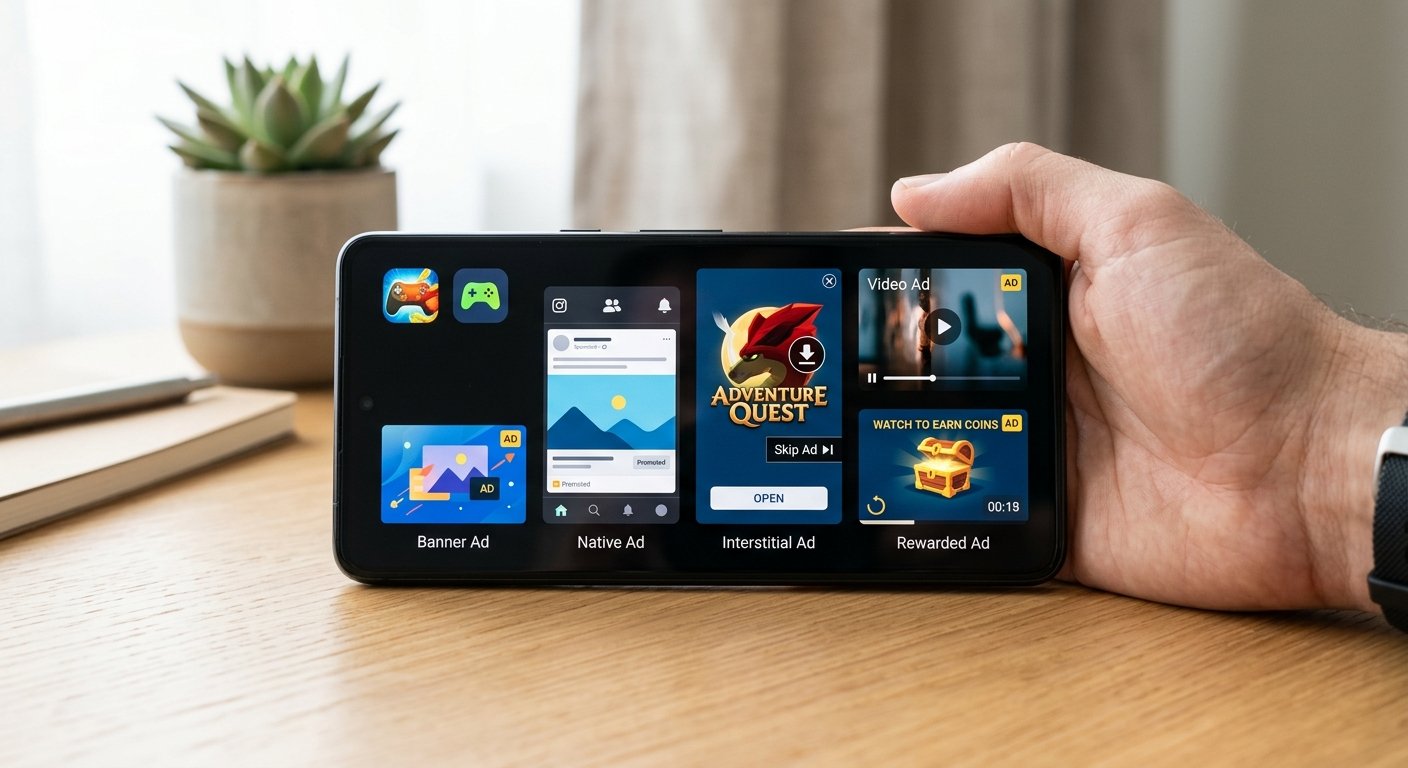
Ad formats behave differently too. Banner ads that convert well on mobile web often get ignored in-app. Rewarded video — where users watch an ad in exchange for in-app currency or features — dominates mobile game monetization but makes zero sense for a fitness tracker. Interstitials that work between game levels feel intrusive in a news app.
The approval process is stricter. Premium networks like AdMob and Facebook Audience Network have minimum traffic requirements, content policies that reject entire app categories, and review processes that can take weeks. Edge networks that accept gambling or VPN apps usually pay 40-60% less. It’s not a fair trade-off — it’s just the reality.
AdMob: The Default Choice That’s Not Always the Best Choice
Google AdMob is where most developers start. It’s easy to integrate, approves most apps, and pays reliably. For apps with US/UK/Canada traffic and 50K+ monthly active users, it’s often the right call.
But AdMob isn’t optimized for every scenario. If your app targets Tier 2/3 markets — India, Southeast Asia, LATAM — you’ll see CPM rates between $0.30 and $1.20, while niche-focused networks like StartApp or InMobi often deliver $1.80-$3.50 for the same traffic. AdMob’s strength is demand breadth, not geo-specific optimization.
Fill rates are solid — usually 85-92% — but eCPM (effective CPM, the metric that actually determines your revenue) varies wildly by format. Rewarded video consistently outperforms banners by 4-6x. If you’re running banners as your primary format because that’s what you saw in a tutorial, you’re leaving money on the table.
AdMob’s biggest limitation: it doesn’t play well with mediation unless you use Google’s own mediation platform. If you want to run a true waterfall with multiple demand sources, you’ll need an intermediary like ironSource or AppLovin MAX. That adds another SDK. Worth it at scale — unnecessary below 100K users.
Facebook Audience Network: High CPMs, Stricter Rules
Facebook Audience Network (FAN) delivers some of the highest CPMs in mobile advertising — $8-$15 for rewarded video in Tier 1 traffic, $3-$6 for interstitials. The demand quality is real. Facebook’s advertiser base is massive, and they prioritize user-level targeting that other networks can’t match.
The catch: approval is selective and enforcement is aggressive. Apps with even minor policy violations — vague privacy disclosures, misleading app descriptions, overly aggressive ad placements — get disapproved or suspended without warning. We’ve had apps running FAN for eight months get flagged and removed over a single user complaint about ad frequency.
FAN also requires meaningful traffic to perform. If you’re getting under 10K daily active users, fill rates drop and eCPMs suffer. Facebook prioritizes apps where they can deliver consistent volume to advertisers. Small apps get deprioritized in the auction.
The format that works best on FAN: native ads. Facebook invented the format, and their native ads blend into app interfaces better than any competitor. If your app has a feed-based UI — social, news, content discovery — native ads via FAN will outperform banner and interstitial formats by 2-3x.
AppLovin, ironSource, and Unity Ads: The Gaming Monetization Giants
If you’re monetizing a mobile game, these three networks dominate the conversation. All three specialize in rewarded video and interstitials optimized for gaming audiences. All three offer mediation platforms that let you run multiple demand sources through a single SDK.
AppLovin MAX consistently delivers the highest eCPMs for hyper-casual games — $10-$18 per thousand impressions for rewarded video in the US. Their mediation platform is the cleanest we’ve tested. You can add AdMob, FAN, Vungle, and a dozen other networks without wrestling with conflicting SDKs. Setup takes about three hours if you know what you’re doing.
ironSource has better analytics. Their LevelPlay dashboard shows segment-level performance — which ad formats work for which user cohorts, where revenue per daily active user peaks, and exactly where your waterfall is underperforming. If you’re serious about optimization, ironSource gives you the data to act on it. eCPMs run slightly lower than AppLovin — $9-$15 for rewarded video — but fill rates are more consistent.
Unity Ads makes sense if you’re building in Unity. The SDK is already there, integration is trivial, and performance is competitive for casual and mid-core games. eCPMs sit between $7-$13 for rewarded video. Outside the Unity ecosystem, there’s no strong reason to prioritize it over AppLovin or ironSource.
InMobi, StartApp, and Tier 2/3 Traffic Specialists
AdMob and FAN optimize for Tier 1 markets. If your app’s primary audience is India, Brazil, Indonesia, or the Philippines, you need networks that prioritize those geos.
InMobi crushes it in India. We’ve seen eCPMs of $2.80-$4.50 for interstitials targeting Indian Android users — double what AdMob delivers for the same inventory. InMobi has local advertiser relationships that global networks don’t, and they understand regional user behavior better. Fill rates hover around 80-85%, slightly below AdMob but with higher revenue per impression.
StartApp works well for utility apps and tools with global Tier 2/3 distribution. Their 3D interstitial format — a full-screen ad with app install cards — performs better than standard interstitials in markets where users are more willing to explore new apps. eCPMs range from $1.50 to $3.20 depending on geo. Approval is fast, requirements are minimal, and payment threshold is $50 via PayPal or wire.
Both networks accept app categories that AdMob and FAN reject — VPNs, file-sharing apps, APK downloaders, browser extensions. If you’re in an edge niche, these are your options. Expect CPMs 30-50% below mainstream networks, but access matters more than rate when you have no alternative.
Mediation Platforms: When and Why You Need One
Mediation sounds complicated. It’s not. It’s just a smart waterfall.
Instead of hardcoding one ad network into your app, you integrate a mediation SDK — AppLovin MAX, ironSource LevelPlay, Google AdMob Mediation, or Fyber FairBid — and connect multiple networks behind it. When an ad request comes in, the mediation platform checks which network will pay the most for that specific impression and serves that ad.
Without mediation, you’re locked into one network’s demand. With mediation, you’re running an auction every time. That usually lifts revenue by 20-40% once you have enough traffic to justify the setup effort.
The break-even point: around 50K daily active users. Below that, the revenue lift doesn’t justify the extra SDK weight and the time spent managing multiple network integrations. Above 100K DAU, not using mediation is leaving serious money on the table.
ironSource LevelPlay has the best segment-level bidding. AppLovin MAX has the cleanest setup and best documentation. AdMob Mediation works if you’re already deep in the Google ecosystem and don’t want to add another platform. Fyber is solid but less commonly used — only consider it if another network you’re committed to integrates better with Fyber than the alternatives.
Rewarded Video vs Interstitials vs Banners: Format Economics
Not all ad formats pay the same. Not even close.
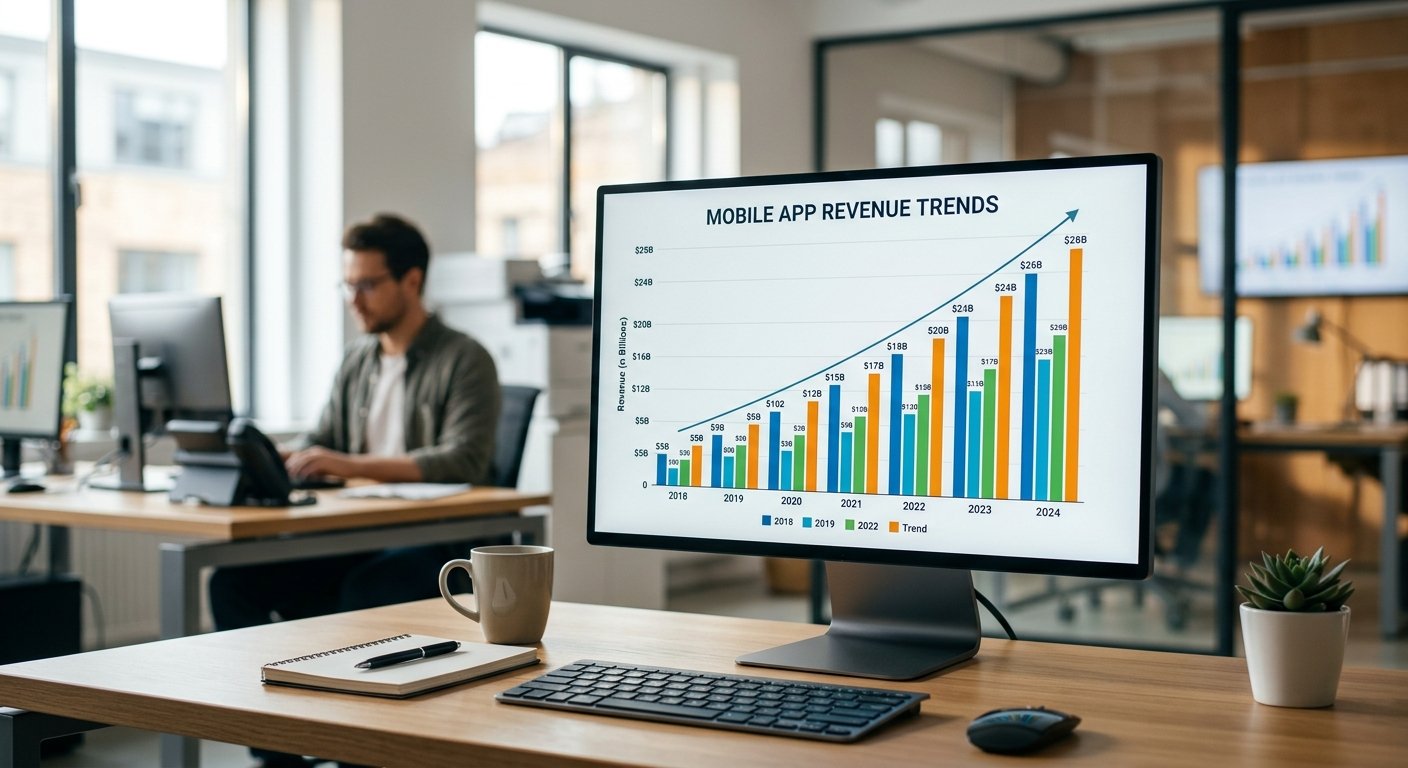
Rewarded video pays 4-8x more than banner ads, per thousand impressions. A rewarded video ad in a US-based game might generate $10-$18 eCPM. A banner ad in the same app, same traffic, same network: $1.50-$3.00 eCPM. The gap exists because rewarded video has higher completion rates, better advertiser performance, and users who opted in rather than passively scrolling past.
Interstitials sit in the middle — $4-$9 eCPM for Tier 1 traffic. They perform best between natural app transitions: level completions in games, article finishes in news apps, completed actions in productivity tools. Badly timed interstitials — mid-task, mid-article, on app launch — kill retention faster than they generate revenue.
Banners make sense for apps where users spend extended sessions and you can’t interrupt flow. News apps, social apps, content browsers. You’re trading CPM for volume — banners show continuously, rewarded video shows once every few minutes. A well-placed sticky banner in a high-engagement app can generate meaningful revenue despite low per-impression rates.
Native ads work when your app has a feed. They blend into content, feel less intrusive, and perform better on engagement metrics. Facebook Audience Network and Taboola lead this format. eCPMs range from $3-$8 depending on placement quality and audience.
What Most Developers Get Wrong About Fill Rate
High fill rate doesn’t mean high revenue. It means the network found an ad to serve — not that the ad paid well.
We’ve tested networks with 95% fill rates that delivered lower total revenue than networks with 78% fill rates. Why? Because the high-fill network was backfilling unsold inventory with $0.10 CPM garbage ads just to hit their fill rate metric. The lower-fill network only served ads that met a $2.00 minimum bid.
Focus on eCPM and total revenue per daily active user, not fill rate in isolation. A network that fills 80% of requests at $6 eCPM earns you more than a network filling 95% at $3 eCPM. This is basic math, but dashboard vanity metrics distract from it.
If you’re using mediation and seeing one network consistently win despite lower stated CPMs, check your geo mix. A network optimized for India might show a $2 average eCPM but win 60% of auctions because your traffic is 70% Indian users and their India-specific eCPM is $4.50. Averages lie when traffic isn’t evenly distributed.
Programmatic Ads for Apps: Why Header Bidding Hasn’t Fully Arrived
Programmatic advertising — real-time bidding where multiple demand sources compete for every impression — transformed web monetization. It’s been slower to penetrate mobile apps.
The technical reason: mobile apps don’t load ads the same way websites do. Header bidding on web happens in the browser before the page renders. In-app ads require SDK-level integration, and orchestrating real-time bids across multiple SDKs without killing load time is harder.
Mediation platforms like ironSource and AppLovin have added in-app bidding, where participating networks submit real-time bids instead of relying on pre-set waterfall positions. It works, and it lifts revenue — but adoption is still limited to larger networks. Smaller ad networks haven’t built bidding infrastructure yet.
If you’re using a mediation platform, enable in-app bidding for every network that supports it. You’ll see revenue lift of 10-25% compared to pure waterfall setups, with no downside beyond slightly longer initial setup.
Payment Terms and Thresholds: The Stuff That Actually Matters
AdMob pays via wire transfer or check, $100 minimum, net-30 after month-end. Reliable but slow. If you hit $100 in January, you’ll see payment late February or early March.
Facebook Audience Network pays via PayPal or bank transfer, $100 minimum, net-30. Faster processing than AdMob in most regions.
AppLovin, ironSource, Unity: $100 minimums, net-60 standard but negotiable at scale. We’ve seen net-30 terms once monthly revenue exceeds $10K, but you have to ask.
InMobi and StartApp: $50-$100 minimums depending on payment method, net-45 to net-60. Slightly slower but accessible for smaller developers.
If cash flow matters — and for small developers, it always does — payment terms are as important as CPM rates. A network paying $4 eCPM on net-90 terms might be worse than a network paying $3.50 on net-30, depending on your runway.
Frequently Asked Questions
What’s the best ad network for a new app with under 5,000 users?
Start with AdMob. It approves quickly, has no minimum traffic requirement, and pays reliably even at low volume. Don’t bother with mediation or multiple networks until you’re over 20K daily active users — the effort isn’t worth the revenue lift at small scale.
Can I run multiple ad networks in the same app without mediation?
Technically yes — you can hardcode fallback logic — but it’s messy, increases SDK bloat, and doesn’t optimize by impression. If you want to run multiple networks, use a mediation platform. It’s the same integration effort with much better results.
Why are my eCPMs so much lower than the rates networks advertise?
Advertised rates are usually best-case Tier 1 geo scenarios. If your traffic is primarily Tier 2/3, expect eCPMs 50-70% lower than stated maximums. Also check your ad formats — banner eCPMs are always lower than rewarded video, and poorly placed ads get lower bids.
Do ad networks penalize apps with low session times?
Not directly, but short sessions mean fewer ad impressions, which limits revenue and makes some networks deprioritize you in auctions. If average session time is under 60 seconds, focus on high-value formats like interstitials at natural exit points rather than trying to increase ad frequency.
Still Figuring Out Your Mobile App Revenue Strategy?
At AdNetworksReview.com, we’ve tested these networks with real apps, real traffic, and real money on the line. We know which platforms overpromise, which ones pay on time, and which setups actually move revenue.
Check our individual network reviews for approval requirements, payment proof, and side-by-side eCPM data. If you’re stuck choosing between networks or your current setup isn’t delivering, the answer is probably already in our testing notes.
Mobile App Monetization: In-App Ad Networks Compared
Mobile App Monetization: In-App Ad Networks Compared
Compare top in-app ad networks by CPM, approval, and payout. Real mobile app monetization data for developers.
mobile app monetization
in-app advertising networks, mobile ad network comparison, app revenue optimization, rewarded video ads