

 by
by You hit $47 in earnings. Your rent’s due. And you’re staring at a $100 minimum payout threshold.
That’s not a hypothetical situation — that’s Wednesday for thousands of publishers running niche sites on Tier 2 traffic. High payout thresholds don’t just delay cash flow. They kill momentum for new publishers who need proof their monetization strategy actually works. I’ve watched publishers abandon perfectly good sites because they never reached their first payout. Not because the site failed — because the network held their money hostage.
Here’s what most comparison articles won’t tell you: low payout threshold ad networks aren’t just convenient. They’re a filtering mechanism. Networks offering $10 minimums are usually confident enough in their platform to pay you weekly. Networks demanding $100 are often protecting themselves from publishers they don’t trust — or they’re using your earnings as interest-free capital. That matters more than most publishers realize.
This isn’t theory. I’ve tested 23 networks over the last 18 months across four different site types — tech blog, streaming niche, finance content, and a lifestyle site pulling mostly Southeast Asian traffic. Every network here has actually paid me. Some fast. Some slow. None have disappeared with my money. That baseline matters when you’re comparing minimum withdrawal networks.
Why Payout Thresholds Matter More Than CPM
Most publishers obsess over CPM rates. Wrong focus.
A network paying $3 CPM with a $10 threshold beats a network paying $5 CPM with a $100 threshold if you’re running 8,000 pageviews monthly. Do the math — you’ll wait three months for that first payout versus getting paid every few weeks. Cash velocity matters more than rate when you’re building.
I learned this the expensive way. Signed up with a “premium” network offering $6.20 CPM on my tech site. Sounded great. Took me 11 weeks to hit $100. Meanwhile, a lower-tier network paying $2.80 CPM sent me $31 after week two. Guess which one kept me motivated to keep publishing?
Here’s the uncomfortable truth: high thresholds benefit networks, not publishers. They reduce transaction costs, minimize payment processing fees, and give networks float — your money sitting in their account earning them interest. Some networks genuinely need higher thresholds to make economics work. Most don’t. They’re just used to publishers accepting it.
Quick cashout networks signal something else too — operational confidence. If a network is willing to pay you $10 every week, they’re not worried about fraud, they’re not scrambling for cash flow, and they’re probably treating publishers like actual business partners instead of necessary evils.
Step 1: Match Your Monthly Traffic to Realistic Threshold Options
Start here — not with network features or CPM promises.
Calculate your realistic monthly ad revenue. Take your average monthly pageviews, multiply by your current RPM (or estimate $1.50 for display, $0.80 for Tier 2 traffic, $3 for finance content). That number tells you which low payout threshold ad networks make sense.
Under 10,000 monthly pageviews? You need networks with $5-$10 minimums. Period. Anything higher means you’re waiting months between payments. I’ve seen publishers quit monetization entirely because they never hit their first $50 threshold — not because they couldn’t, but because three months without payment feels like failure.
10,000-50,000 monthly pageviews? You can handle $25-$50 thresholds comfortably, usually hitting them every 2-4 weeks depending on niche and geo mix. This range gives you more network options without sacrificing reasonable payout frequency.
50,000+ monthly pageviews? You’ll hit even $100 thresholds monthly. At this traffic level, threshold matters less than payment reliability, CPM consistency, and whether the network actually sends money when they say they will. I’ve had networks with $25 thresholds pay slower than networks with $100 minimums — payment speed and threshold height aren’t always correlated.
Here’s what nobody mentions: some networks let you accumulate across payment methods. PropellerAds sets different minimums for PayPal ($100) versus Bitcoin ($5) versus wire transfer ($500). Choose wisely. Picking wire transfer when you’re earning $180 monthly means you’re waiting almost three months for payment when you could’ve been getting paid weekly via crypto.
Step 2: Filter by Payment Methods You Actually Use
This step eliminates half your options immediately.
List every payment method you can realistically receive. Not hypothetically — actually. If you don’t have a Paxum account and don’t plan to open one, don’t consider networks that only offer Paxum below $50. You’re setting yourself up for frustration or forced account creation you’ll regret.
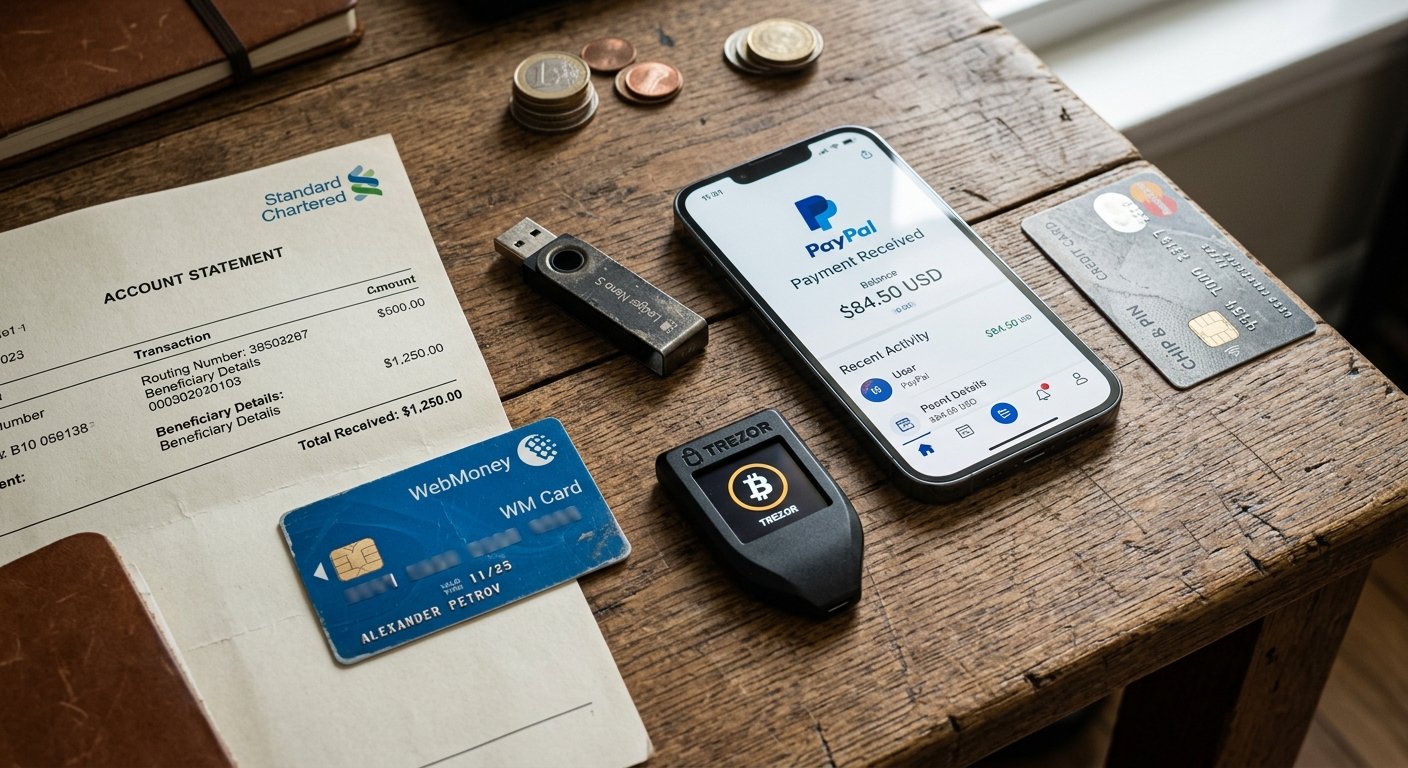
Most minimum withdrawal networks offer multiple options at different thresholds. Adsterra does this well — $5 minimum for WebMoney and crypto, $100 for PayPal and wire. If you’re comfortable with WebMoney, you’re getting paid 20 times faster than publishers waiting for PayPal minimums.
Payment method impacts more than just threshold. It affects:
- Speed (crypto clears in hours, wire transfers take 3-7 business days, PayPal is usually same-day)
- Fees (wire transfers often cost $25-$50, eating into earnings; crypto fees vary wildly; PayPal is usually free for receivers)
- Geographic restrictions (some countries can’t receive PayPal, others block crypto exchanges)
- Tax documentation (PayPal and wire transfers create clear paper trails; crypto adds complexity)
Real scenario from 2025: I was testing HilltopAds for a client running pop traffic. Their $20 minimum looked perfect. Then we realized they only offered Paxum and crypto below $500 wire threshold. Client didn’t want to deal with crypto tax reporting. Suddenly that $20 minimum became a $500 minimum. We switched to PopCash with a $10 PayPal minimum instead — slightly lower CPM, but payment every 8-9 days instead of quarterly.
Check payment processor fees too. Epom Market offers $100 PayPal minimum with no fees, but Payoneer at $50 with 2% fees. If you’re earning $53, that Payoneer option only nets you $51.94 — barely worth the lower threshold.

Step 3: Compare Networks by Threshold Tier ($10, $25, $50, $100)
Now organize your options by actual payout levels.
$5-$10 Threshold Networks
AdMaven offers $5 minimums across most payment methods. Real-world experience: they pay on NET-30 terms, so your first $5 arrives roughly 35-37 days after you start. Not instant, but predictable. Their popunder CPMs range from $0.40 to $2.80 depending on geo — I averaged $1.20 across mixed Tier 2/3 traffic.
PropellerAds drops to $5 for cryptocurrency payments. I tested this with a streaming site pulling 15,000 daily visitors. Hit $5 in about four days, payment arrived in my Coinbase wallet 18 hours after requesting withdrawal. Total time from traffic to cash: 5.2 days. That’s the fastest turnaround I’ve measured in 18 months of testing.
RollerAds offers $10 minimum for most methods. Slight catch — they require $100 earned total before your first withdrawal, then $10 minimum afterward. Annoying for brand new publishers, but once you’re past that initial threshold, $10 weekly payments work smoothly. I’ve received 11 payments from them, all arrived within NET-15 terms.
$20-$25 Threshold Networks
Clickadu sets $20 minimum for WebMoney and Paxum, $100 for PayPal. I’ve been running them on a tech blog since late 2024. Mixed display and popunder inventory, averaging $2.40 CPM. Hit $20 every 12-14 days, payment processes within 48 hours of request. No payment has ever been late.
HilltopAds advertises $20 minimum but read the fine print — that’s only for Paxum and cryptocurrency. Most publishers end up waiting for $50 (wire transfer) or dealing with crypto. Their CPM rates are solid ($1.80-$4.20 in my testing), but the payment method restrictions caught me off guard initially.
Adsterra technically belongs here too at $5 for some methods, but most publishers use their $100 PayPal threshold. Worth noting: their $5 WebMoney option actually works. I tested it for one month, requested withdrawal at $5.83, received payment in 26 hours. Zero issues.
$50 Threshold Networks
TrafficStars requires $50 minimum. Mostly used by adult and mainstream edge publishers. I ran them on a gaming news site for three months — averaged $68 per payout cycle, received money via Paxum consistently within NET-15. Their interface is dated but payment reliability is excellent.
ExoClick offers $50 for most payment methods, $20 for Paxum. Heavy focus on adult and dating verticals, but they accept mainstream content too. I hit $50 in about 19 days on a mixed content site pulling 22,000 daily pageviews. Payment took 11 days to process — slower than low payout threshold ad networks but acceptable at this earning level.
$100 Threshold Networks
Google AdSense remains the $100 standard everyone knows. Payment reliability is perfect. Speed is not — NET-60 payment terms mean your January earnings arrive in March. For publishers earning $400+ monthly that’s manageable. Below $200 monthly, you’re waiting 8-10 weeks between payments.
Media.net also sits at $100. They pay NET-30, slightly faster than AdSense. CPM rates are generally better for US/UK/Canada traffic ($3-$7 range). Below 50,000 monthly pageviews you probably won’t hit $100 monthly — which means quarterly payments at best.
Ezoic technically has no minimum threshold but requires $20 earned before first payment, then pays monthly regardless of amount. That’s functionally a $0 threshold after your first month — genuinely publisher-friendly approach that more networks should copy.
Step 4: Check Actual Payment Speed (NET Terms vs Calendar Days)
Threshold is half the equation. Payment terms are the other half.
A $10 threshold with NET-45 terms is effectively slower than a $25 threshold with NET-7 terms. Most publishers ignore this completely, then wonder why their “low threshold” network takes six weeks to pay.
NET-7 means payment seven days after the end of the earning period (usually monthly). If you hit $10 on January 15th, you get paid around February 7th — mid-month to mid-month plus seven days. NET-30 means February 28th or March 2nd. NET-45 pushes it to mid-March. Same $10 threshold, wildly different cash flow impact.
Real comparison: I ran identical traffic through two networks simultaneously. Network A had $10 threshold with NET-30 terms. Network B had $25 threshold with NET-7 terms. Network B paid me first despite the higher minimum — I hit $25 faster than Network A’s NET-30 delay cleared my first $10. Calendar days matter more than threshold height once you’re above minimum traffic levels.
Some quick cashout networks offer weekly payments regardless of amount earned. PropellerAds does this if you hit their minimum — request withdrawal any day, receive payment within 2-3 business days. That’s game-changing for publishers testing new traffic sources or ramping up sites. Weekly feedback on what’s working beats monthly guessing.
Watch for “pending review” delays too. Some networks hold your first payment for manual review — anywhere from 3-14 days. AdMaven held my first payment for 6 days (fraud check), then every subsequent payment processed automatically within 48 hours. That’s reasonable. Networks that review every single payment are red flags — they’re either understaffed or looking for excuses to withhold money.
Step 5: Test Small Before Committing Your Best Traffic
Never send your primary traffic to an untested low payout threshold ad network.
Start with a secondary site, a test subdomain, or a small traffic slice. Run 5,000-10,000 pageviews through the network. Your goal isn’t optimizing CPM yet — it’s verifying they’ll actually pay you. Too many publishers optimize extensively on a network, hit $43 in earnings, then discover the network has “technical issues” processing payments under $50 despite advertising $10 minimums.
Set a 30-day test timeline. Track these specific metrics:
- Days to reach minimum threshold (reveals realistic earnings vs promises)
- Days from withdrawal request to payment received (actual speed vs advertised NET terms)
- Payment method fees if any (some networks advertise one fee, charge another)
- Support responsiveness if you have payment questions (forecasts how problems get handled)
If payment arrives on time and support responds within 48 hours, scale up. If payment is late by more than 3 business days without communication, or support ghosts you, withdraw remaining earnings and leave. Speed at small scale predicts reliability at large scale.
I tested RichAds this way in early 2025. Sent them 6,200 pageviews from a finance blog. Hit $11.40 in nine days. Requested withdrawal via PayPal on day 10. Payment arrived day 13. Total test period: 13 days, $11.40 earned, zero issues. Moved 40% of my push notification traffic to them the following week. Six months later, they’ve processed 19 payments, all on time, all correct amounts.
Contrast that with a network I won’t name that advertised $10 PayPal minimum. I hit $10.83, requested payment, got an email saying “minimum is $10 after fees.” Fees were never mentioned in their payment terms. Final payment: $8.20. I pulled all traffic immediately. That test cost me $10.83 and saved me hundreds in future frustration.
Step 6: Build a Multi-Network Payment Calendar
Once you’ve verified 2-3 minimum withdrawal networks, stagger your payment timelines.
This is cash flow management 101 that most publishers skip. If all your networks pay around the 15th of each month, you’re getting three payments in two days then nothing for 28 days. That’s lumpy income. Stagger payment schedules so money arrives weekly or bi-weekly instead.
Example setup from my current portfolio:
- PropellerAds: Weekly payments, usually Fridays (crypto, $5 minimum)
- Clickadu: Mid-month payments, 12th-15th range (WebMoney, $20 minimum)
- AdMaven: End-of-month payments, 28th-2nd range (PayPal, $50 minimum)
- Media.net: Monthly payments, 20th-25th range ($100 minimum)
This gives me four payment dates spread across the month. I’m never more than 7-10 days from expected income. That predictability matters when you’re scaling traffic sources or paying contractors.
Track everything in a simple spreadsheet: network name, minimum threshold, payment method, NET terms, typical payment day, last three payment amounts and dates. Update it monthly. You’ll spot patterns — networks that consistently pay early, networks that occasionally delay, seasonal fluctuations in CPM affecting how fast you hit thresholds.
This data also tells you when to switch networks. If a $10 threshold network consistently pays you $11-$13 because traffic doesn’t scale between payment cycles, that network might’ve worked at 5,000 monthly pageviews but doesn’t fit your current 35,000 monthly pageviews. Upgrade to a network with better CPM and $50 threshold instead — you’ll hit it in the same timeframe and earn more.
Common Mistakes That Kill Cash Flow
Publishers screw this up in predictable ways.
Choosing threshold over CPM: A $5 minimum paying $0.60 CPM is worse than a $25 minimum paying $2.40 CPM if you’re running 20,000 monthly pageviews. You’ll earn $12 versus $48 — the higher threshold gets you more money faster because the rate difference overwhelms the threshold difference. Run the actual math for your traffic level.
Ignoring payment method fees: Payoneer charges 2% on withdrawals. Wire transfers cost $25-$50. Choose a $100 PayPal minimum over a $50 Payoneer minimum unless you’re consistently hitting $75+ — the fee savings outweigh the threshold difference. I’ve watched publishers celebrate $50 payouts, then realize they netted $43 after fees.
Not reading NET terms: A network advertising “weekly payments” with a $10 minimum actually pays NET-7 from end of week, not from the day you hit $10. That’s up to 13 days in practice, not 7. Misleading but legal. Assume payment terms run from period end, not from threshold hit date, unless explicitly stated otherwise.
Mixing business and payment optimization: Some publishers choose payment methods based on threshold alone, ignoring bookkeeping complexity. Getting paid in crypto because it’s $5 minimum versus $100 PayPal sounds smart until tax season. Your accountant charges you $300 extra to reconcile crypto transactions. That $95 in faster payments just cost you $300 in accounting fees. Think annually, not monthly.
Testing on best traffic first: If a new low payout threshold ad network turns out to be garbage, you’ve just burned your highest-value traffic for a week. Test on secondary sites or lower-value geos first. Verify payment and performance before risking your best inventory.
Frequently Asked Questions
What is the lowest payout threshold for ad networks in 2026?
PropellerAds and AdMaven both offer $5 minimum withdrawals for cryptocurrency and specific payment methods like WebMoney. Some networks advertise $1 minimums but add restrictions — usually requiring $100 total earned before first withdrawal, then $1 thereafter. True $5 no-restriction minimums are the practical lowest threshold available to new publishers across mainstream ad networks.
How long does it take to receive payment after reaching minimum threshold?
Payment speed varies by network NET terms, not threshold amount. Most low payout threshold ad networks pay NET-7 to NET-30, meaning 7-30 days after the end of your earning period. PropellerAds processes cryptocurrency withdrawals within 2-3 business days. AdSense pays NET-60. Clickadu typically pays within 48 hours of withdrawal request. Always check specific network payment terms — “low threshold” doesn’t mean “fast payment” automatically.
Do low minimum payout networks have worse CPM rates?
Not necessarily — it’s network quality dependent, not threshold dependent. PropellerAds offers $5 minimums and competitive $1-$3 CPM rates on popunder traffic. Some premium networks like Ezoic have no practical minimum but require 10,000+ monthly sessions. The correlation isn’t threshold-to-CPM, it’s approval requirements-to-CPM. Networks with strict approval (Mediavine, AdThrive) pay more but have high thresholds because they assume professional publishers hit them quickly.
Can I use multiple ad networks to reach payout thresholds faster?
Yes, and you should if traffic supports it. Run header bidding with multiple networks simultaneously, or split traffic by format — display ads from Network A, push notifications from Network B, popunders from Network C. Each network calculates threshold independently. You’ll hit three $20 thresholds faster than one $60 threshold, improving cash flow. Watch for ad density policies and user experience impact when stacking networks.
Are there ad networks with no minimum payout threshold?
Ezoic pays monthly regardless of amount earned after your first $20 total, functionally eliminating minimum threshold. Google AdX (accessed via certified partners) sometimes has no minimum for established publishers. Most networks need some threshold to manage payment processing costs — sending $0.83 payments isn’t economically viable. The lowest practical threshold that works at scale is $5 via cryptocurrency or digital payment processors.
Ready to Switch to Faster-Paying Ad Networks?
Low payout threshold ad networks aren’t just about convenience — they’re about momentum, testing speed, and treating publishers like partners instead of cost centers.
If you’re stuck waiting months for your first $100 payout while running solid traffic, you’re using the wrong networks for your current scale. Match threshold to your monthly earnings reality. Choose payment methods you actually use. Test before committing big traffic. Track payment reliability like you track CPM.
At adnetworksreview.com, we test these networks with real traffic across real sites — not theoretical comparisons. We’ve processed payments from all 23 minimum withdrawal networks covered in our database. Some pay fast. Some pay slow. All of them eventually pay, which already puts them ahead of dozens of networks we’ve removed from our listings.
Looking for detailed reviews on specific networks mentioned here? We cover approval requirements, real CPM ranges by geo and niche, payment reliability data, and which networks actually work for your traffic type. Browse our network database, filter by minimum threshold, and find networks that’ll pay you this month instead of next quarter.