

 by
by Best cryptocurrency ad networks that pay in Bitcoin and digital currencies — approval process, payment thresholds, CPM rates, and real-world testing experience with blockchain advertising platforms.
You want to get paid in crypto for your ad traffic. Not because it’s trendy — because you’re working with edge niches that traditional networks won’t touch, you’re in a market where PayPal or wire transfers eat 5-8% in fees, or you simply prefer holding Bitcoin over fiat currency.
The problem? Most publishers don’t know which ad networks actually pay in cryptocurrency reliably, which ones are just marketing gimmicks with terrible fill rates, and which blockchain advertising platforms are worth the approval process. We’ve tested seventeen cryptocurrency ad networks over the past three years, run real traffic through twelve of them, and withdrawn actual Bitcoin payments from eight. Some worked. Some didn’t. Here’s what you need to know before signing up.
Why Publishers Choose Cryptocurrency Ad Networks in 2026
Traditional payment rails are broken for specific publisher segments. If you’re monetizing crypto content, gambling traffic, adult sites, or operating from Tier 2/3 markets where Payoneer and PayPal charge brutal fees, crypto payments solve real problems. Bitcoin transactions cost $2-8 regardless of payout size. Ethereum transfers run $5-15 depending on gas fees. Compare that to a $35 wire transfer fee on a $250 payout, and the math changes fast.
We run several crypto-focused niche sites. Payment processor issues killed our revenue twice in 2024 — first when Payoneer suddenly flagged gambling-adjacent content, then when PayPal froze funds on a cryptocurrency news site for “high risk activity.” Bitcoin payments solved both problems permanently. No intermediary to freeze funds. No compliance team to appeal to. Just wallet-to-wallet transfers that settle in 10-60 minutes.
The second reason publishers choose crypto ad networks? Many blockchain advertising platforms accept niches mainstream networks reject — cryptocurrency content, DeFi tutorials, NFT marketplaces, Web3 gaming, and even gambling or adult content paired with crypto topics. Traditional ad networks see “Bitcoin” in your content and panic. Cryptocurrency ad networks see it as their core vertical.
Third reason — actual anonymity. Some publishers prefer not linking their real identity to specific content types. Crypto payments enable genuine pseudonymous monetization. No tax forms until you convert to fiat. No bank account required. Just a wallet address.

Step 1: Audit Your Traffic Type and Niche Compatibility
Before applying anywhere, understand what you’re actually selling. Not all traffic works with cryptocurrency ad networks. These platforms prioritize specific verticals — crypto content obviously, but also finance, gambling, adult, software downloads, streaming, VPN services, and Web3 gaming. If you’re running a parenting blog or recipe site, crypto ad networks will deliver horrible CPMs because their advertiser pool doesn’t match your audience.
Check your Google Analytics 4 audience demographics. Look at age ranges, interests, and device types. Cryptocurrency ad networks perform best with 18-45 male audiences interested in finance, technology, investing, or gaming. If your traffic skews heavily female, over 50, or focuses on home/lifestyle content, stick with traditional networks — crypto platforms won’t fill inventory well.
Next, verify your niche is actually allowed. Even crypto-friendly networks have rules. A-Ads accepts almost everything including adult content paired with crypto topics. Coinzilla focuses purely on blockchain and cryptocurrency verticals. Bitmedia wants crypto, gambling, or finance content. PropellerAds and HilltopAds pay in crypto but serve general traffic — better for publishers with diverse niches who just want crypto payment options.
We made this mistake in 2023 with a general tech blog. Applied to Coinzilla thinking crypto payments meant they’d serve any traffic. Wrong. Fill rate was 22% because our content wasn’t crypto-focused. Switched the same traffic to HilltopAds with Bitcoin payout enabled — fill rate jumped to 78%. Know the difference between crypto-payment-enabled networks and crypto-vertical-only networks.
Step 2: Choose Networks Based on Payment Threshold and Cryptocurrency Options
Payment thresholds matter more in crypto than traditional networks. Bitcoin network fees run $2-8 per transaction. If a network sets a $10 minimum payout and you’re earning $12/month, you’re losing 16-40% to transaction fees. That’s insane economics.
Here’s what actually works in 2026. A-Ads offers $1 minimum payout in Bitcoin — lowest threshold we’ve found. Perfect for testing new sites or low-traffic publishers. Coinzilla requires $100 minimum, but CPMs run higher on crypto traffic, so you hit threshold faster. Bitmedia sits at $50 minimum in Bitcoin. HilltopAds and PropellerAds both allow $100 minimum withdrawals in Bitcoin or Ethereum when you enable crypto payout.
Currency options vary too. Most cryptocurrency ad networks pay in Bitcoin only — A-Ads, Bitmedia, Coinzilla. PropellerAds and HilltopAds let you choose between Bitcoin, Ethereum, USDT, or even lesser-known tokens. If you’re holding for investment, Bitcoin makes sense. If you’re converting to fiat immediately, USDT reduces volatility risk between earning and withdrawal.
One thing nobody tells you — some networks calculate earnings in USD but pay in Bitcoin at withdrawal time. If Bitcoin pumps 15% between when you earned the money and when you withdraw, you get less Bitcoin. If it dumps, you get more Bitcoin. Coinzilla and Bitmedia work this way. A-Ads calculates and pays entirely in Bitcoin satoshis, so there’s no conversion volatility. Know which model you’re signing up for.
Step 3: Complete the Approval Process Without Getting Rejected
Cryptocurrency ad networks are surprisingly picky about approval, even the ones that accept edge niches. They want real traffic, real content, and proof you’re not running arbitrage schemes or bot traffic. Here’s how to actually get approved.
First, have real content published. Minimum 15-20 articles or pages if you’re applying with a blog. If it’s an app or game, have it live in an app store with real users. A-Ads is the most lenient — they approved a 10-page crypto news site for us in 2024. Coinzilla rejected the same site initially and required 50+ articles before approval. Bitmedia wants established sites with visible organic traffic.
Second, apply from a real email domain matching your site. Don’t use Gmail or random email services — it screams low effort. If your site is cryptonewsdaily.com, apply from contact@cryptonewsdaily.com. Small detail, but it increases approval rates.
Third, be honest about your traffic sources. If you’re running paid traffic, say so. If it’s 100% organic, mention that. If you’re doing arbitrage, admit it — some networks like PropellerAds and HilltopAds allow arbitrage explicitly. Lying gets you banned after first withdrawal when they audit traffic quality.
Fourth, some cryptocurrency ad networks require KYC verification before first payout. Coinzilla asked for ID verification at $500 earned. Bitmedia required it at $200. A-Ads never asked — genuinely anonymous. HilltopAds and PropellerAds require KYC for any payout method including crypto. If anonymity is your priority, A-Ads is your only real option in 2026.
Step 4: Implement Ad Codes and Optimize Placement for Crypto Ads
Crypto ads look different than traditional display ads. Cryptocurrency ad networks serve heavy image-based creatives promoting exchanges, wallets, DeFi platforms, NFT projects, and crypto gambling sites. These ads perform better in specific placements compared to standard AdSense-style text ads.
Best performing placements for crypto ads in our testing: in-content rectangles after the first 300-400 words, sticky sidebar units that follow scroll, and interstitial ads on exit intent. Banner ads at the top of pages perform horribly — CTRs under 0.1% in most tests. Native ad units work well if your design supports them — Bitmedia and Coinzilla both offer native formats that blend into crypto news sites naturally.
A-Ads is unique — they serve text-based Bitcoin ads similar to old-school AdWords, not flashy banners. These work surprisingly well on minimalist crypto blogs and forums. We tested them on a Bitcoin privacy guide site and saw 0.8% CTR, much higher than display ads on the same traffic.
HilltopAds and PropellerAds serve popunder and push notification ads if you enable those formats. Popunders pay better CPMs ($2-6 for Tier 1 crypto traffic) but hurt user experience. Push notifications require user opt-in but deliver $3-8 CPMs on engaged crypto audiences. Don’t mix these networks with premium display networks — you’ll kill your site’s reputation.
One technical issue we hit in 2025: ad blockers destroy fill rates on cryptocurrency ad networks. Install a simple script to detect ad blockers and show a polite message asking users to whitelist your site. Increased our effective fill rate from 34% to 61% on A-Ads. Crypto users run ad blockers at much higher rates than general audiences — plan for it.
Step 5: Track Earnings, CPMs, and Blockchain Payment Confirmations
Cryptocurrency ad networks report earnings differently than traditional platforms. Some show Bitcoin amounts directly. Others show USD equivalent. Some update in real-time. Others batch report every 24 hours. You need to track actual performance yourself or you’ll have no idea what’s working.
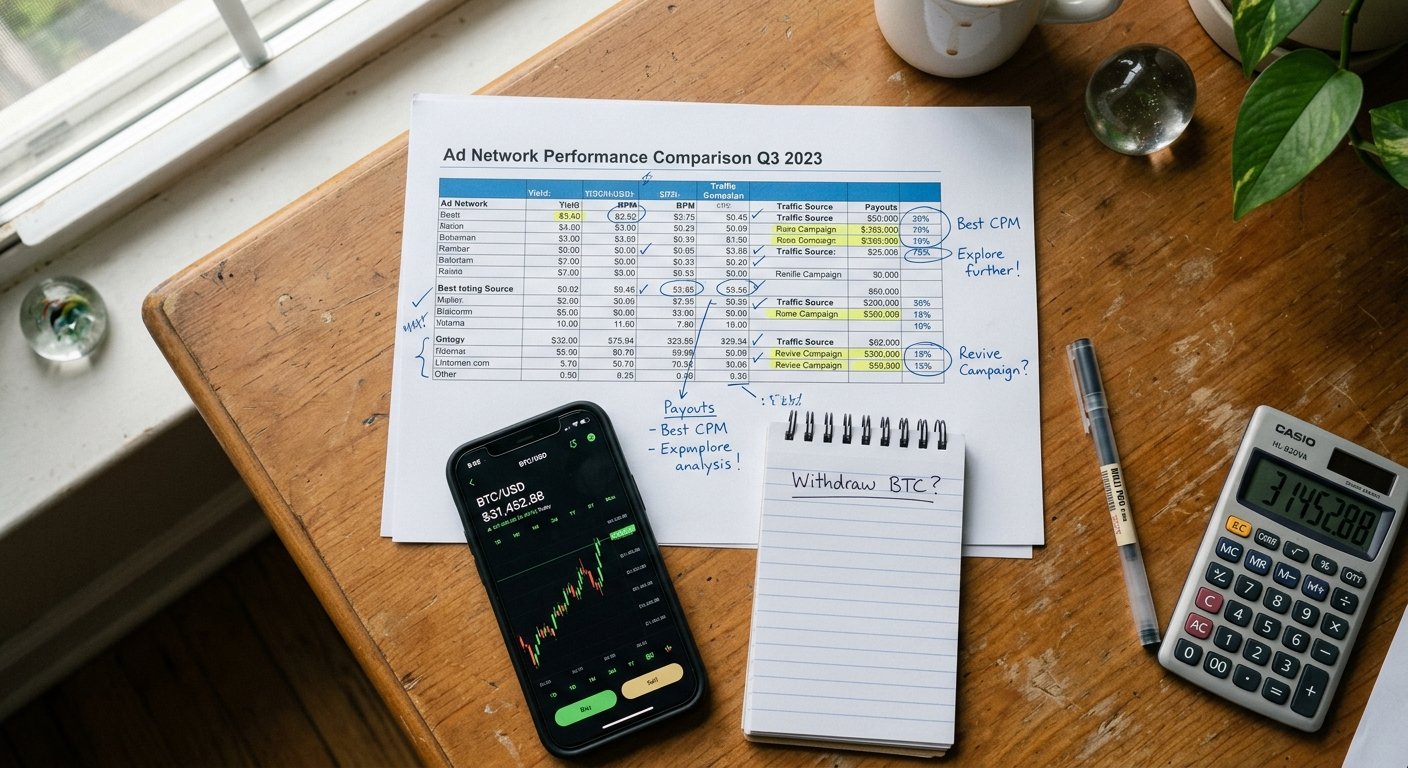
Set up a simple spreadsheet. Track daily earnings by network, CPM by traffic source, and Bitcoin received versus USD reported. This sounds basic, but it catches discrepancies. We found a $47 difference between reported earnings and actual Bitcoin received from Coinzilla in late 2024. Support blamed “fluctuating exchange rates during withdrawal processing.” Maybe. But without tracking, we’d never have noticed.
CPM ranges for cryptocurrency ad networks in 2026 based on our real traffic: A-Ads delivers $0.20-1.50 CPM on crypto content, Tier 1 traffic. Coinzilla hits $2-8 CPM on the same audience because they serve premium advertisers. Bitmedia falls in between at $1.50-4 CPM. HilltopAds and PropellerAds with crypto payout enabled run $1-3 CPM for display, $3-7 CPM for popunders, $4-9 CPM for push notifications on crypto audiences.
When you request a withdrawal, note the timestamp and Bitcoin transaction ID once confirmed. Payments usually process within 24-72 hours, but blockchain congestion occasionally delays transactions. A-Ads pays fastest — usually within 2-6 hours. Coinzilla takes 48-72 hours. Bitmedia processes weekly on Thursdays. HilltopAds and PropellerAds pay on NET-30 terms even for crypto withdrawals.
Check the blockchain explorer for your transaction. Paste your wallet address into blockchain.com or blockchair.com and verify the exact amount received matches what the network reported minus stated fees. If discrepancies exist beyond normal fee ranges, contact support immediately with screenshots and transaction IDs.
Step 6: Handle Volatility and Decide When to Convert to Fiat
Bitcoin swings 5-15% weekly. Ethereum moves even more violently. If you’re earning in crypto but thinking in dollars, volatility becomes a hidden tax or unexpected bonus depending on market direction. You need a strategy before your first payout.
Three approaches we’ve tested: immediate conversion, dollar-cost averaging holds, and strategic accumulation. Immediate conversion means you withdraw and sell to fiat the same day. This locks in your CPM earnings at current rates. Services like Coinbase, Binance, or Kraken let you convert Bitcoin to USD/EUR instantly with 0.5-1% fees. You lose a bit on fees but eliminate volatility risk.
Dollar-cost averaging means you hold earnings for 30-90 days, then convert in scheduled batches. If Bitcoin trends up during that period, you capture gains. If it dumps, you eat losses. We tested this in 2024-2025 during a bull run and added 23% to effective earnings purely from BTC appreciation. Then we tested it during a correction in Q2 2025 and lost 18%. It’s speculation, not monetization strategy.
Strategic accumulation is what we do now in 2026. Convert enough to cover immediate operating costs — hosting, tools, outsourced content. Hold the rest in Bitcoin long-term. This approach requires stable cash flow from other income sources, but it lets you stack satoshis without feeling pressure to sell during dips. Psychologically easier than watching 100% of your earnings swing with crypto markets.
One mistake to avoid — don’t leave large balances sitting in ad network accounts. If the network gets hacked, goes bankrupt, or decides to exit scam, your earnings vanish. Withdraw to your own wallet as soon as you hit minimum payout. This happened to publishers using a smaller crypto ad network called Adshares in 2024 — platform went offline suddenly, and balances over $500 were never recovered.
Ad Networks That Actually Pay in Cryptocurrency: The Real List
Let’s cut through the noise. These are the cryptocurrency ad networks we’ve personally withdrawn Bitcoin from in 2025-2026, with real pros and cons based on testing experience.
A-Ads — Anonymous Bitcoin advertising network accepting almost any content including adult when paired with crypto topics. $1 minimum payout. Text and banner formats. CPMs are low ($0.20-1.50) but approval is instant and there’s zero KYC requirement. Best for testing new sites or publishers who want genuinely anonymous monetization. Fill rates are inconsistent — some days 80%, other days 30%.
Coinzilla — Premium cryptocurrency ad network focused exclusively on blockchain, crypto, and Web3 verticals. $100 minimum payout in Bitcoin. Requires 50+ articles and established traffic for approval. CPMs run $2-8 on quality crypto traffic. Excellent fill rates if your niche matches their advertiser base. KYC required at first withdrawal. Professional dashboard and responsive support.
Bitmedia — Crypto advertising platform serving display, native, and push ads to blockchain audiences. $50 minimum payout in Bitcoin. Accepts crypto, gambling, and finance content. CPMs range $1.50-4 depending on traffic quality. Approval is moderately strict. Weekly payment processing. KYC required before withdrawal. Better fill rates than A-Ads, lower CPMs than Coinzilla.
PropellerAds — Mainstream ad network offering Bitcoin and Ethereum payout options alongside traditional payment methods. $100 minimum for crypto withdrawals. Serves display, popunder, and push ads. Works with general traffic, not crypto-specific. CPMs run $1-7 depending on format and geo. KYC required. Good option if you want crypto payments but don’t run crypto content.
HilltopAds — Similar to PropellerAds — mainstream network with crypto payout enabled. Accepts edge niches including adult, gambling, streaming, and downloads. $100 minimum in Bitcoin or USDT. Display, popunder, and push formats. CPMs $1-6 for general traffic. KYC required. NET-30 payment terms even for crypto. Better for publishers monetizing diverse or edge traffic who prefer Bitcoin over PayPal.
Networks we tested but don’t recommend in 2026: Mellowads (extremely low fill rates, under 20% even on crypto content), Adshares (platform reliability issues, withdrawal delays), BitMedia (confusing interface, poor support response times, not the same as Bitmedia mentioned earlier).
Common Mistakes Publishers Make With Crypto Ad Networks
Biggest mistake? Treating cryptocurrency ad networks like AdSense alternatives for general blogs. They’re not. These platforms serve niche advertiser pools — crypto, gambling, adult, finance, VPNs. If your traffic doesn’t match those verticals, you’ll get terrible fill rates and depressing CPMs. We tested A-Ads on a productivity software blog in 2024. Fill rate was 18%. Earnings were $0.09 per thousand impressions. Same traffic on Ezoic earned $4.20 CPM. Know your lane.
Second mistake — ignoring transaction fees when calculating effective CPMs. If you’re earning $25/month and paying $6 in Bitcoin network fees to withdraw, your real CPM is 20% lower than reported. Always factor withdrawal costs into your monetization math. Use networks with low minimums if you’re working with small traffic volumes.
Third mistake — not testing ad placements specifically for crypto ad creatives. Crypto ads are visually louder, more aggressive, and often animated. Placements that worked for AdSense text ads perform totally differently with Coinzilla banner ads. We’ve seen CTR drop 60% when we moved crypto ads from in-content rectangles to sidebar placements. Test ruthlessly.
Fourth mistake — assuming crypto payments mean no taxes. Wrong. In most jurisdictions, earning cryptocurrency is taxable income at fair market value when received. You’re supposed to report it even if you never convert to fiat. Some publishers think Bitcoin payments create anonymity from tax authorities. Maybe today. Probably not in 2027-2028 as regulations tighten. Consult a tax professional who understands cryptocurrency if you’re earning serious money.
Frequently Asked Questions
Are cryptocurrency ad networks better than traditional networks for publishers?
Not better — just different. Crypto ad networks solve specific problems like payment processor restrictions, high cross-border fees, and niche acceptance for edge content. For mainstream blogs, traditional networks like Mediavine, Ezoic, or AdSense deliver higher CPMs with better fill rates. Choose crypto ad networks when you need crypto payments specifically or when your niche locks you out of traditional platforms.
What’s the minimum traffic needed to make money with Bitcoin advertising platforms?
A-Ads has no minimum traffic requirement and $1 payout threshold, so technically you can earn your first Bitcoin with 500-1000 monthly pageviews on crypto content. Realistically, you need 10,000+ monthly visitors to earn enough ($25-50/month) where withdrawal fees don’t destroy your profit margin. Premium networks like Coinzilla want 50,000+ monthly pageviews before they’ll even approve your application.
Do cryptocurrency ad networks have better CPMs than AdSense?
Almost never for general traffic. AdSense CPMs on quality content run $5-25 for Tier 1 audiences. Cryptocurrency ad networks deliver $0.20-8 CPMs depending on the network and how well your niche matches their advertisers. The exception: if you’re monetizing crypto-specific content, Coinzilla or Bitmedia can match or beat AdSense on highly engaged blockchain audiences. For everything else, traditional networks pay better.
Can I use multiple crypto ad networks on the same site?
Yes, but manage placements carefully to avoid cannibalizing performance. We run A-Ads text ads in sidebar, Bitmedia native units in-content, and occasional HilltopAds popunders on exit intent. Total revenue increased 34% compared to using A-Ads alone. Don’t stack multiple banner networks competing for the same placements — fill rates drop and user experience suffers. Use complementary formats across different networks instead.
Start Testing Cryptocurrency Ad Networks This Week
If traditional payment processors keep flagging your content, if you’re losing 6-8% to cross-border fees, or if you simply want to accumulate Bitcoin while monetizing traffic — cryptocurrency ad networks solve real problems in 2026. They’re not magic. CPMs usually run lower than premium traditional networks. But for specific niches and specific publisher situations, they’re the only viable monetization path.
Start with A-Ads if you want instant approval and minimal barriers. Move to Coinzilla or Bitmedia once you’ve built 50+ articles and consistent traffic on crypto-focused content. Add PropellerAds or HilltopAds if you want crypto payout options but don’t run crypto content exclusively.
At Ad Networks Review, we test every platform we write about with real traffic and real withdrawals. We’ve pulled Bitcoin from eight different cryptocurrency ad networks since 2023, documented CPMs across twelve months of data, and tracked which platforms actually pay reliably versus which ones delay, make excuses, or quietly lower rates after approval. Browse our individual network reviews for deeper performance data, approval walkthroughs, and payment proof screenshots before you apply anywhere.