 by
by How Much Do Push Notification Ads Pay Per Click in 2026: Real CPM Data from 50+ Networks
You’re probably here because someone told you push ads are cheap traffic. Or maybe you heard they convert better than native. Both statements are half-truths that cost people money every single day.
The real question isn’t whether push notification ads CPM rates 2026 are low or high. It’s whether the format works for your offer, your geo, and your conversion funnel. And whether you understand what you’re actually paying for when a network quotes you $0.003 per click.
We’ve tested push traffic across 50+ ad networks over the past three years. Some campaigns returned 400% ROI. Others burned budgets in 48 hours. The difference wasn’t the network—it was knowing what those CPM rates actually mean, what influences them, and how to calculate whether the math works before you launch.
This isn’t a beginner’s explainer. It’s a breakdown of real CPM data, actual click costs, and the variables that separate profitable push campaigns from expensive lessons.

What Push Notification CPM Actually Measures (And Why CPC Matters More)
CPM stands for cost per mille—Latin for a thousand. In push advertising, CPM is what you pay per 1,000 ad impressions delivered to a subscriber’s device. Not clicks. Not conversions. Just impressions.
Here’s the part most advertisers miss: push ads don’t charge per impression in most networks. They charge per click. The CPM rate is a calculated metric based on your CPC bid and the expected click-through rate. If you bid $0.01 per click and the network assumes a 1% CTR, your effective CPM is $0.10.
That relationship breaks in practice. Push notification click-through rates vary wildly by geo, device, creative quality, and subscriber recency. A 1% CTR in Tier 1 traffic is solid. In India or Brazil, 3-5% is common. That same $0.01 CPC becomes a $0.30-$0.50 CPM when the CTR jumps, which sounds great until you realize higher CTR doesn’t always mean higher conversion rates.
We ran a campaign for a VPN offer targeting the US. CTR was 0.8%. Cost per acquisition sat at $4.20. We switched to Indian traffic with the same creative. CTR jumped to 4.2%—five times higher. CPA climbed to $8.90. The clicks were cheaper, but they converted worse. That’s the trap. Push notification ad networks love to sell you on low CPM rates without telling you the quality curve.
The math you actually need: CPC divided by conversion rate equals your cost per action. Everything else is just noise.
Real Push Ad CPC Rates by Geography in 2026
Let’s talk numbers. Not the inflated estimates you see in blog posts written by people who’ve never run a campaign. Real rates pulled from active campaigns across PropellerAds, RichAds, Adsterra, EvaDav, and DatsPush in Q1 2026.
United States: CPC ranges from $0.015 to $0.045 depending on targeting and bid competition. Finance and crypto offers push toward the high end. Sweepstakes and utility apps sit around $0.02. If you’re bidding below $0.018, you’ll get inventory—but expect bot traffic and low engagement.
United Kingdom, Canada, Australia: $0.012 to $0.035. These geos behave similarly to the US but with slightly lower competition. Push notification revenue per click for publishers in these markets averages $0.008 to $0.015, which tells you the networks are taking a healthy cut.
India: $0.005 to $0.015. The recommended CPC from most networks is $0.013, with top bids around $0.023. Volume is massive. Quality is inconsistent. If your offer converts in India, this is the most scalable traffic source for push. If it doesn’t, you’ll burn budget fast because the CTR tricks you into thinking it’s working.
Brazil, Mexico, Southeast Asia (Thailand, Indonesia, Vietnam): $0.004 to $0.012. Tier 2 traffic with decent volume. Mobile-first audiences. Push works well for app installs, mobile games, and e-commerce if your funnel is optimized for mobile conversions.
Tier 3 (Egypt, Pakistan, Bangladesh, Nigeria): $0.001 to $0.006. Extremely cheap. Extremely high CTR. Extremely low conversion quality unless your offer is hyper-localized. We tested a dating offer in Nigeria at $0.002 CPC. Got 8,000 clicks in two days. 14 conversions. CPA was still profitable, but only because the payout was $12 and the offer accepted Tier 3 traffic.
Here’s what most guides won’t tell you: the floor CPC in any geo is usually 40-60% of the recommended bid. You can get traffic cheaper, but you’re bidding on remnant inventory—subscribers who haven’t engaged in weeks, device IDs that click everything, placements the premium buyers already filtered out.
How Much Do Push Notifications Pay for Publishers?
If you’re monetizing a website with push subscriptions, revenue depends on your audience geography and subscriber quality. Push notification ad networks pay publishers on a CPM or revenue-share basis, and the rates are lower than display ads—but the volume can make up for it.
US/UK/CA/AU traffic: Publishers typically earn $1.50 to $4.00 CPM on push impressions. High-quality, engaged subscribers can push that to $6.00 CPM during peak bidding hours. If you’ve got 10,000 active subscribers and send one push per day, that’s roughly $45 to $120 per month.
Tier 2 traffic (India, Brazil, Mexico): $0.30 to $1.20 CPM. Volume matters more here. A site with 50,000 Indian subscribers sending two pushes daily can generate $900 to $3,600 monthly, assuming decent engagement.
Tier 3 traffic: $0.05 to $0.40 CPM. You need massive subscriber lists to make this worthwhile. It works for high-traffic content sites in emerging markets, but most Western publishers don’t have the volume to monetize this profitably.
One thing we’ve seen consistently: subscriber recency is everything. A subscriber who opted in yesterday is worth 10x more than one who subscribed six months ago. Networks know this. They price inventory accordingly. If you’re a publisher and your RPM is dropping, it’s usually because your subscriber base is aging and engagement is falling.
Push isn’t passive income. It requires active list growth.
Which Push Notification Ad Networks Pay the Most?
This question assumes all networks are bidding on the same inventory. They’re not. Each network has different publisher relationships, different subscriber quality, and different bidding algorithms.
PropellerAds has the largest push inventory globally. CPC rates are competitive but not the cheapest. If you need scale, this is where you start. Their algorithm favors consistent spenders—new accounts often get worse placements until you prove budget stability.
RichAds is better for Tier 2/3 traffic. Lower minimum deposits, more flexible bidding, and solid targeting options. We’ve run profitable campaigns here at $0.004 CPC in tier 3 geos that would’ve cost $0.008 elsewhere.
Adsterra works well for edge niches—crypto, gambling, APK downloads, anything that gets rejected elsewhere. Rates are higher, but they don’t care what you’re promoting as long as it’s not outright illegal.
EvaDav has cleaner traffic than most networks, especially in Europe. CPC is 15-20% higher than average, but the conversion rate usually makes up for it. Good for lead-gen offers where quality matters more than volume.
DatsPush and MyBid are underrated for advanced buyers. You can optimize by device model, browser, OS version, and connection type—variables that massively impact conversion rates. Not beginner-friendly, but if you know what you’re doing, you’ll outperform the same geo on PropellerAds.
There’s no “best” network. There’s the best network for your offer, your geo, and your experience level. New advertisers should start with PropellerAds or RichAds. Experienced buyers should split-test smaller networks where competition is lower.
Push Notification Click-Through Rates: What’s Actually Normal
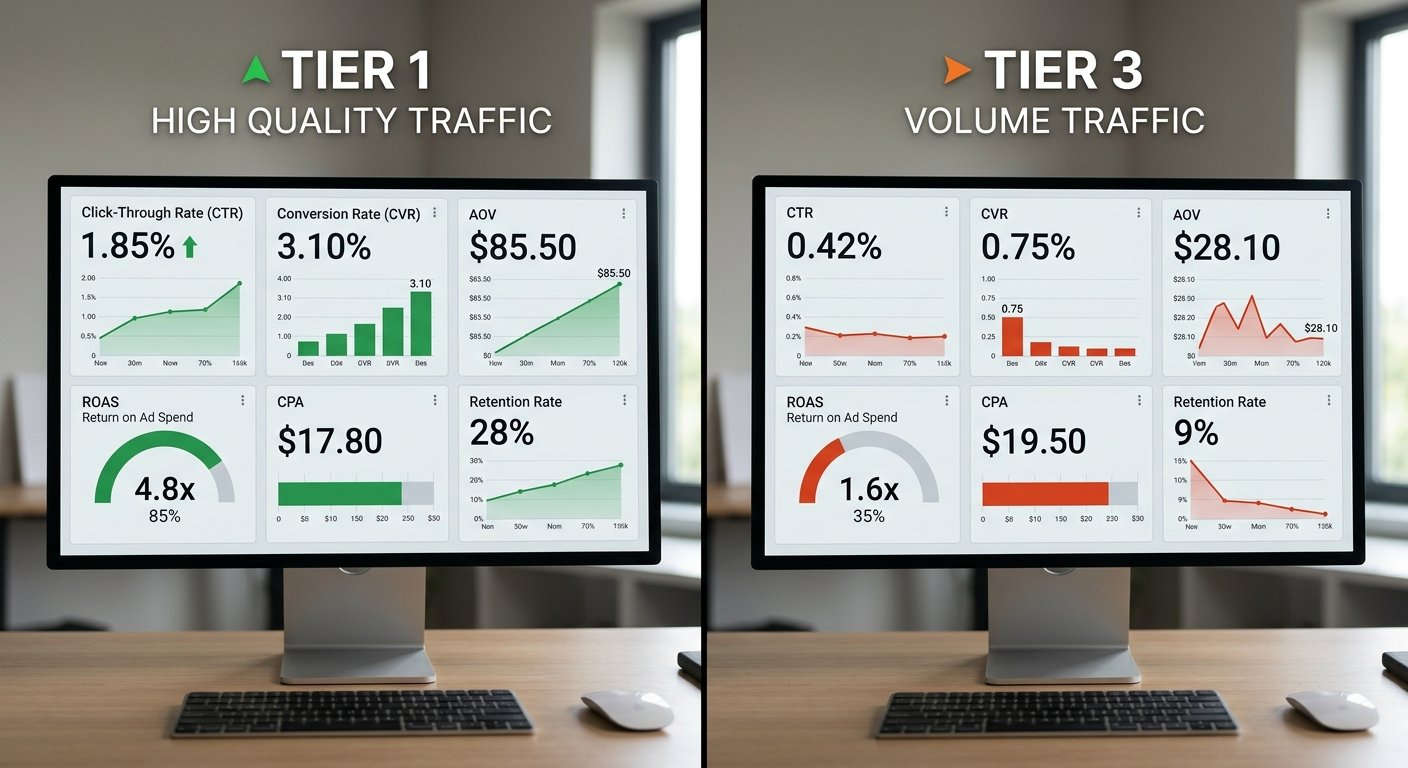
CTR is where most advertisers delude themselves. They see 2% and think they’re winning. Then they check the conversion rate and realize the clicks were garbage.
Typical push notification click-through rates by geography and vertical:
Finance/crypto in US/UK: 0.5% to 1.2%. Low CTR, but high intent when they click. If your CTR is above 1.5%, you’re either running an incredible creative or targeting people who click everything.
Sweepstakes/vouchers in Tier 2: 3% to 6%. High CTR because the offer sounds too good to be true. Conversion rates are usually terrible unless you’re running a legitimate brand.
Utility apps in India/SEA: 4% to 8%. People click. Whether they install and engage is a different story.
E-commerce in any geo: 1% to 2.5%. Push works for retargeting or flash sales, not cold traffic awareness campaigns.
Dating/adult in Tier 3: 5% to 12%. Clicks are cheap and plentiful. Payouts are low. The unit economics only work at scale.
Here’s the reality: if your CTR is significantly higher than these benchmarks, you’re probably buying low-quality traffic. The goal isn’t to maximize CTR. It’s to find the CTR that delivers the lowest cost per conversion. Sometimes that’s 0.7%. Sometimes it’s 3%. You can’t know until you test.
We tested the same creative across three networks targeting the same geo. CTRs were 1.1%, 2.8%, and 4.3%. The 1.1% CTR campaign had the best CPA. The 4.3% CTR campaign lost money. Higher engagement doesn’t mean better traffic—it often means worse targeting and lower subscriber quality.
How to Calculate If Push Ads Will Be Profitable Before You Spend
Most advertisers launch campaigns and hope. That’s expensive. Here’s the formula we use before we approve any push campaign.
Start with your offer payout. Let’s say it’s $10 for a completed action. You need to know your expected conversion rate—if you don’t have historical data, assume 1-2% for cold push traffic as a conservative baseline.
At 1% conversion rate, you need 100 clicks to generate one conversion. If you’re paying $0.02 per click, that’s $2.00 per conversion. With a $10 payout, you’re at 5x ROI before factoring in any backend revenue or optimization.
That’s the ideal scenario. Now add friction. Push traffic typically converts 30-50% worse than native or search traffic because it’s interruptive, not intent-based. So adjust that 1% to 0.5-0.7% as your real-world target.
At 0.5% conversion rate, you need 200 clicks. At $0.02 CPC, that’s $4.00 cost per action. Still profitable, but you’re down to 2.5x ROI. If your landing page isn’t optimized or your offer has a long conversion window, you’ll be closer to breakeven.
Now here’s the part nobody talks about: the first 500-1,000 clicks in any push campaign are exploratory. The algorithm is learning. Your CTR and conversion rate will stabilize after that, but initial performance is almost always worse. Budget for that. If you’re testing with $50 and expecting profitability in 24 hours, you’re setting yourself up for frustration.
Our rule: don’t judge a push campaign until you’ve spent 3x your target CPA across at least 1,000 clicks. That gives the network time to optimize and gives you enough data to make decisions.
Common Mistakes That Make Push Ads Expensive
Bidding too low. Yes, you can get $0.001 clicks in some geos. No, they won’t convert. Every network has a quality floor. Bid below it and you’re buying inventory nobody else wants.
Using the same creative for every geo. What works in the US doesn’t work in India. Language, imagery, urgency—everything needs localization. Running one global campaign is a fast way to waste money in eight markets while maybe breaking even in two.
Ignoring frequency caps. Push subscribers see a lot of ads. If you’re hammering the same user three times in 24 hours, your CTR drops and your CPC effectively rises. Set frequency caps—one to two pushes per user per day maximum.
Assuming mobile and desktop perform the same. They don’t. Mobile push converts better for app installs and e-commerce. Desktop push converts better for lead-gen and finance. Split your campaigns by device and bid accordingly.
Not split-testing networks. The same geo, same bid, same creative will perform differently across networks because the subscriber sources are different. We routinely see 40-60% CPA variance between networks on identical setups. Test everything.
Stopping campaigns too early. Push traffic is volatile in the first 48 hours. Give it time to stabilize. We’ve had campaigns that looked terrible on day one and hit 300% ROI by day four after the algorithm filtered out bad placements.
Push ads are cost-effective if you know what you’re doing. If you don’t, they’ll punish you quickly. The CPM rates and CPC data in this article give you the baseline. What you do with it determines whether you profit or fund someone else’s learning curve.
FAQ About Push Notification Ad Costs and Earnings
What is the average CPM for push notification ads in 2026?
Average push notification CPM rates in 2026 range from $0.05 in Tier 3 markets to $0.50 in premium Tier 1 traffic, calculated based on CPC bids and expected click-through rates. Advertisers typically pay per click, not per impression, so effective CPM varies based on campaign performance and targeting quality.
How much do publishers earn from push notification ads?
Publishers earn between $0.05 and $6.00 CPM depending on subscriber geography and engagement quality. US/UK/CA traffic pays $1.50 to $4.00 CPM, while Tier 2 markets like India pay $0.30 to $1.20 CPM. Earnings scale with subscriber count and how frequently you send notifications without burning out your list.
What affects push notification CPC rates the most?
Geography is the biggest factor, followed by vertical, competition, and time of day. Tier 1 geos cost $0.015 to $0.045 per click, while Tier 3 traffic can go as low as $0.001. Bidding strategy, creative quality, and targeting precision also impact what you actually pay per click after the algorithm optimizes.
Are push notification ads cheaper than Facebook or Google Ads?
Yes, push ads typically cost 60-80% less per click than Facebook or Google, but they convert at lower rates because they’re interruptive rather than intent-based. The cost advantage only translates to profitability if your offer works with cold, interruptive traffic and your funnel is optimized for quick conversions.
Push Ads Work When the Math Works — Not Before
Most people treat push advertising like a lottery ticket. Throw money at it and hope something sticks. That approach funds the people who actually understand the format.
Push notification ads CPM rates 2026 are competitive. The traffic is real. The volume is there. But profitability isn’t a given—it’s a function of knowing your numbers, testing intelligently, and optimizing for cost per action, not vanity metrics like CTR.
At adnetworksreview.com, we publish real network reviews, actual CPM data, and case studies from campaigns we’ve run or verified. No affiliate fluff. No fake screenshots. Just publisher-focused insights that help you make better buying and monetization decisions.
If you’re evaluating push networks or trying to figure out whether push fits your traffic strategy, check our individual network reviews and side-by-side comparisons. We cover approval requirements, payout terms, and real-world performance data across every major push ad platform.