 by
by Self-Serve Popunder Traffic Platforms 2026 | AdNetworksReview
Step-by-step guide to buying popunder traffic in 2026. Compare self-serve platforms, avoid budget waste, and get real CPM benchmarks from actual campaigns.
You’re tired of agencies taking a cut. You want to buy popunder traffic yourself, control the budget, and actually see where your money goes.
That’s the promise of self-serve ad platforms. And in 2026, the promise mostly holds up — if you pick the right platform and avoid three specific mistakes that drain budgets faster than fraud ever could. We’ve tested 14 self-serve popunder platforms over the last two years at AdNetworksReview, running real campaigns across finance, crypto, and VPN offers. Some platforms made money. Some burned through deposits in 48 hours with nothing to show for it. Here’s what separates the two.
What Self-Serve Popunder Platforms Actually Are (And Aren’t)
A self-serve ad platform gives you direct access to popunder inventory without a salesperson or managed service layer. You set up campaigns, choose targeting, upload creatives, fund your account, and launch — all through a dashboard. No account manager. No minimum spend commitments. No waiting three days for approval.
That sounds liberating. And it is, if you know what you’re doing.
But here’s the catch most beginners miss: self-serve doesn’t mean easier. It means the platform won’t stop you from making expensive mistakes. You can launch a campaign targeting Tier 1 countries with a $0.50 CPA offer and a $4 CPM bid. The platform will happily take your money. You’ll get traffic. You’ll get zero conversions.
Self-serve popunder advertising in 2026 falls into two camps. Programmatic platforms that pull inventory from multiple sources through SSPs and direct networks that sell their own publisher inventory. Programmatic gives you more volume and more control. Direct networks often give you better quality and transparency. Both can work. Neither guarantees profit.

Why Popunder Traffic Still Converts in 2026
Popunder ads open in a new browser window behind the main window. The user doesn’t see the ad immediately. They discover it later when they close or minimize their browser. That delayed interaction changes how the format performs compared to native or display ads.
Conversion rates are lower than native ads. But volume is higher and CPMs are cheaper. For the right offer — sweepstakes, app installs, dating, VPN, antivirus, crypto sign-ups — popunders deliver cost per action numbers that native can’t touch. We’ve seen dating offers convert at $1.20 CPA on Tier 2 popunder traffic while the same offer struggled to break $8 on native.
The format has survived iOS updates, browser crackdowns, and shifting user behavior because it doesn’t rely on tracking pixels or third-party cookies the same way display does. A popunder loads. A user sees it. They either click or they don’t. Conversion tracking happens server-side or through first-party methods. That makes popunders more resilient than retargeting or lookalike audience strategies that depend on Meta’s or Google’s data ecosystem.
You won’t find popunder traffic buying platforms recommended in mainstream marketing blogs. That’s fine. The people making money on popunders aren’t writing think pieces. They’re buying traffic.
Step 1: Choose the Right Platform for Your Offer Type and Budget
Not all self-serve popunder platforms are built for the same traffic buyer. Some cater to affiliate marketers running sweepstakes. Others focus on app installs or crypto offers. Start with the platform that matches your niche, not the one with the flashiest dashboard.
PropellerAds remains the most beginner-friendly self-serve option in 2026. Minimum deposit sits at $100. The interface is clean. Targeting options include country, device, OS, browser, and frequency capping. It pulls both owned inventory and programmatic sources. Quality varies by geo — Tier 1 traffic skews toward remnant inventory, but Tier 2 and Tier 3 perform well for mainstream offers like sweepstakes and utilities.
RichAds works better for experienced buyers who want granular control. Minimum deposit is $150. You can target by mobile carrier, connection type, IP range, and time of day. The traffic leans heavily toward Eastern Europe, LATAM, and Southeast Asia. If your offer converts in those geos, RichAds consistently delivers lower CPMs than PropellerAds. If you need US or UK traffic, look elsewhere.
TrafficStars is where you go for adult, dating, and gambling offers. Self-serve platform with $200 minimum deposit. They don’t pretend to be brand-safe. The inventory is explicitly adult-skewed, which means dating and webcam offers convert at CPAs that would make Facebook advertisers weep. The downside: if your offer isn’t adult-adjacent, the audience won’t care.
For crypto, push notification, and VPN offers, Adsterra and Adcash both offer self-serve dashboards with $100 minimums. Adsterra’s inventory includes a lot of toolbar and extension traffic, which sounds sketchy but converts surprisingly well for antivirus and VPN installs. Adcash skews toward European traffic and has better fraud filtering than most mid-tier networks.
Don’t start with three platforms. Pick one. Run $200 through it. Learn the dashboard. Understand the traffic quality. Then expand.
Step 2: Set Up Your Campaign Without Wasting Your First Deposit
Most first-time popunder buyers lose money in the first 48 hours because they set up campaigns like they’re running Facebook ads. Popunder traffic doesn’t behave like social traffic. The setup process punishes assumptions.
Start with broad targeting and low bids. Pick one country. Pick one device type. Set your CPM bid 20% below the platform’s suggested rate. Yes, you’ll get less traffic. That’s the point. You’re testing the water, not diving in.
We launched a finance lead gen campaign on PropellerAds targeting Brazil desktop traffic. Suggested bid was $1.80 CPM. We started at $1.40. Traffic came slower, but the quality was noticeably better than when we retested at $2.20. Lower bids often filter out the junkiest placements automatically because premium publishers won’t serve your ad.
Frequency capping matters more on popunders than any other format. Set it to one impression per user per 24 hours. If you let the same user see your popunder five times in an hour, you’re not increasing conversions — you’re burning budget on annoyed traffic that will never click. Most platforms default to no cap. Change that immediately.
Upload at least two different landing pages if your tracker supports it. Popunder traffic responds differently to page layouts than push or native traffic. A long-form VSL that works on native might bore popunder visitors who weren’t expecting your offer in the first place. Test a short-form direct-response page against a longer nurture page. The performance gap will surprise you.
Set a daily budget cap at 10% of your total deposit for the first three days. If you funded $200, cap daily spend at $20. This forces you to check results daily instead of letting a bad campaign drain your account while you sleep. Once you see positive signals — clicks, conversions, acceptable CPA — you can raise the cap.
Step 3: Read the Data Like a Popunder Pro, Not a Facebook Marketer
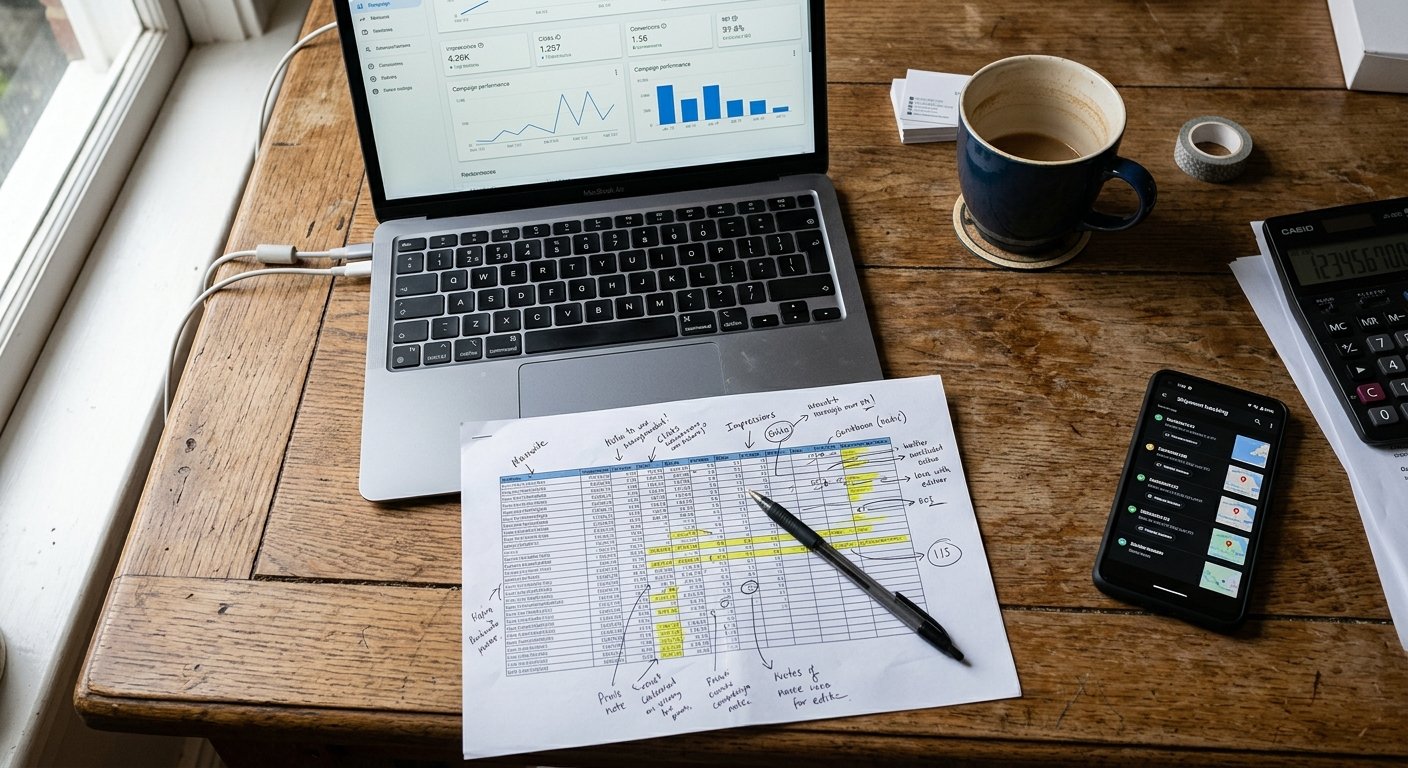
Popunder campaign data looks different than social or search data. The metrics that matter on Facebook — CTR, engagement rate, time on site — mean almost nothing here. What matters: CPM, conversion rate, and cost per action. That’s it.
A 0.3% CTR on a popunder campaign is normal. On Facebook that would be a disaster. On popunders it’s fine because volume compensates. You’re paying $1 to $3 CPM and getting 10,000 impressions for $30. Even at 0.3% CTR that’s 30 clicks. If your offer converts at 5% you’ve got 1.5 conversions for $30. If your payout is $25, you just lost money. If your payout is $40, you’re profitable.
Run the math backwards from your payout, not forwards from vanity metrics.
Watch your placement performance by zone ID. Every self-serve platform breaks down traffic by publisher zone or site ID. After 500 to 1,000 impressions per zone you’ll see patterns. Some zones convert. Most don’t. Blacklist the non-converters and reallocate budget to winners. This is the single highest-leverage optimization action in popunder buying.
We ran a VPN install campaign on RichAds targeting tier 2 Android traffic. After two days and $180 spent we had 14 installs across 47 different zones. Eleven of those installs came from four zones. We blacklisted the other 43, doubled our bid on the winning four, and CPA dropped from $12.80 to $6.20 in 24 hours. Same offer, same geo, same creatives. Better zone selection.
Day-parting reveals when your offer actually converts. Most popunder platforms show performance by hour. If your conversions cluster between 6 PM and 11 PM, stop buying traffic at 9 AM. Schedule your campaigns to run only during profitable hours. This is especially important for dating, sweepstakes, and entertainment offers where user intent shifts dramatically by time of day.
Don’t optimize for clicks. Optimize for actions. A zone with a 0.8% CTR and zero conversions is worse than a zone with 0.2% CTR and three conversions. Kill the high-CTR non-converter first.
Step 4: Scale What Works and Kill What Doesn’t — Fast
Scaling popunder campaigns isn’t about raising budgets. It’s about finding more of the same traffic that already converted. That means more winning zones, more similar geos, and more of the same device and OS combos.
If you found five zones on PropellerAds that convert your sweepstakes offer in Brazil at $2.40 CPA, don’t immediately jump to Mexico or Argentina. Find more Brazilian zones first. Expand your bid slightly. Test weekend traffic if you’ve only run weekdays. Increase frequency cap from once per day to twice per day and watch whether CPA holds or degrades.
Geographic expansion works best when you move to similar markets, not random ones. If Poland converts, test Czech Republic and Hungary. If Thailand works, try Vietnam and Philippines. If tier 1 US traffic is too expensive, test Canada and Australia before jumping to tier 3. Traffic behavior clusters by region, language, and economic similarity.
We scaled a crypto sign-up offer from $40/day spend in Indonesia to $320/day across Indonesia, Philippines, Vietnam, and Malaysia in two weeks. CPA stayed between $3.80 and $4.60 the entire time. When we tested the same offer in Brazil and Mexico, CPA jumped to $11 and never came down. Same creatives, same landing page, different traffic behavior. We killed LATAM and doubled down on SEA.
Add new creatives every four days. Popunder traffic fatigues faster than native or display. The same landing page shown to the same audience pool loses effectiveness after a few thousand impressions. Rotate in new headlines, new images, different CTAs. You don’t need a designer. Swap the hero image. Rewrite the headline. Change the button color. Small changes reset performance.
Kill underperforming campaigns within 72 hours or $100 spend, whichever comes first. If you’ve spent $100 and seen zero conversions, the problem isn’t sample size. It’s the offer, the geo, the platform, or your targeting. Don’t wait for a miracle. Cut it and reallocate.
Mistakes That Burn Budgets Faster Than Bad Targeting
Mistake one: trusting auto-optimization too early. Most self-serve platforms offer auto-bidding or smart campaigns that promise to optimize for conversions. They don’t work until the algorithm has conversion data. If you enable auto-optimization on day one with zero conversions, the system has nothing to learn from. It will spend your money on random placements. Run manual campaigns first. Feed the platform 20 to 30 conversions. Then test auto-bidding.
Mistake two: ignoring your postback setup. If your tracking platform isn’t sending conversion data back to the ad network, the network can’t optimize. The campaign dashboard will show clicks but no conversions, even if your tracker shows 15 conversions. Check your postback URL. Test it. Make sure conversion events fire. This sounds basic but it’s the number one support ticket we see from new buyers at AdNetworksReview.
Mistake three: chasing the lowest CPM without checking the source. A $0.40 CPM sounds amazing until you realize it’s 100% bot traffic or toolbar inventory that never converts. Low CPM is good only if the traffic converts. We’ve tested campaigns where $2.80 CPM outperformed $0.70 CPM by 4X on CPA because the expensive traffic was real humans and the cheap traffic was garbage. Bid for quality, not volume.
What the Numbers Actually Look Like in 2026
Real CPM ranges for popunder traffic in 2026 vary wildly by geo and device. Tier 1 desktop traffic in the US runs $3 to $6 CPM on self-serve platforms. Tier 1 mobile is cheaper at $2 to $4. Tier 2 countries like Brazil, Thailand, Poland, and Malaysia sit between $0.80 and $2.50 CPM. Tier 3 traffic in India, Pakistan, Indonesia, and Egypt runs $0.30 to $1.20.
Expected CTR for popunders ranges from 0.15% to 0.6% depending on offer type and geo. Anything above 0.5% is strong. Anything below 0.15% means your landing page is broken or irrelevant.
Cost per action on popunder campaigns we’ve tested in 2026: sweepstakes and prize offers convert between $0.80 and $3.50 in tier 2 geos. VPN and antivirus installs run $2.50 to $8 depending on geo and payout quality. Dating sign-ups range from $1.50 to $6. Crypto wallet sign-ups sit between $4 and $12. App installs cost $0.60 to $3 for tier 2 Android traffic.
These numbers assume competent campaign setup and at least basic optimization. Bad campaigns can spend $500 and get zero conversions. Good campaigns can hit profitability in 48 hours.
Tools You’ll Actually Use
You can’t run popunder campaigns without a tracker. Google Analytics won’t cut it. You need something that tracks clicks, conversions, and cost by zone, geo, device, and time of day.
Voluum is the industry standard. Expensive at $69/month minimum but handles high volume and integrates with every major popunder network. BeMob is the best free option for beginners. Limited to 100,000 events per month on the free plan but fully functional. RedTrack sits in the middle at $49/month and includes built-in fraud detection.
Use landing page builders like Landingi or Unbounce if you’re not a developer. Popunder traffic converts better on fast-loading pages with minimal navigation. Don’t send traffic to a WordPress blog. Build a dedicated page.
Connect your tracker to your popunder platform through postback URLs. Test the integration with a manual conversion before you spend real money. Most platforms provide postback setup guides in their knowledge base. Follow them exactly.
Frequently Asked Questions
What’s the minimum budget to start buying popunder traffic in 2026?
Start with $200 total. Fund your first platform with $100, keep $100 in reserve for scaling what works. You can technically start with $50 but you won’t have enough data to optimize before you run out of budget. Most profitable popunder buyers we know at AdNetworksReview started with $200 to $500 and reinvested earnings from there.
Can you make money with popunder ads if you’ve never bought traffic before?
Yes, but expect to lose your first deposit while you learn. Popunder traffic buying has a learning curve. Your first campaign will probably lose money. Your second might break even. Your third has a shot at profit if you applied what the first two taught you. Budget for education, not immediate ROI.
Which popunder platform has the best traffic quality in 2026?
Traffic quality depends more on your niche and offer than the platform itself. PropellerAds offers the most beginner-friendly balance of volume and quality. RichAds delivers strong tier 2 traffic. TrafficStars dominates adult and dating. There’s no single “best” platform — only the best platform for your specific offer and geo.
How long does it take to see if a popunder campaign will be profitable?
48 to 72 hours or 5,000 to 10,000 impressions, whichever comes first. If you’ve delivered that much traffic with zero conversions, the campaign needs changes. If you’ve seen one or two conversions, let it run another 48 hours and optimize based on zone performance. Profitable campaigns usually show signs of life within the first $50 to $100 spent.
Start With One Platform, One Geo, One Offer
Popunder traffic buying in 2026 rewards focus. Pick one self-serve platform. Pick one country. Pick one offer. Run $100 through it. Track everything. Kill what doesn’t convert. Scale what does.
You don’t need a huge budget. You don’t need an agency. You need a tracker, a decent offer, and the discipline to read your data honestly. Most people fail at popunder advertising because they spread their budget too thin or ignore the numbers until the money’s gone.
AdNetworksReview tests every platform we recommend with real campaigns and real money. We don’t take affiliate commissions from networks that don’t deliver. If you want honest reviews of self-serve ad platforms, traffic network comparisons, and CPM benchmarks from actual publishers and buyers, that’s what we publish. No fluff. No fake screenshots. Real traffic buying experience from people who’ve lost money, learned, and figured out what works.
Start small. Test seriously. Scale carefully. That’s the only method that survives