
 by
by You’ve got traffic. Now you need to monetize it without killing the user experience.
Push notifications look simple on paper — small CPMs, recurring revenue, non-intrusive format. But pick the wrong network for your niche, and you’ll watch approval rates tank, CPMs crater, or worse, your audience bounce because the ads feel scammy. We’ve tested dozens of push notification networks across tech blogs, finance sites, crypto trackers, APK download portals, and adult entertainment platforms. The difference between a good match and a bad one isn’t just revenue — it’s whether you keep your audience or lose them to subscription fatigue.
This guide walks you through choosing a push notification provider that actually fits your niche, your traffic quality, and your monetization goals. No fluff. Just the decisions that matter.
Step 1: Know Your Traffic Type Before You Pick a Network
Most publishers skip this step. They sign up for the first push network with a referral bonus and wonder why their approval gets rejected or CPMs stay in the basement.
Here’s the reality — push notification platforms care about three things: your niche, your geo mix, and your traffic source. A network optimized for Tier 1 finance traffic won’t pay well for Tier 3 streaming sites. A platform built for crypto and gambling won’t approve your parenting blog. You need to map your traffic profile before you even look at network lists.
Start with your niche. If you’re in tech, SaaS reviews, or productivity, you’re in a safe, advertiser-friendly category. Networks like OneSignal, PushEngage, and Subscribers might approve you quickly, but their CPMs for direct ad monetization are often lower because competition is thin. If you’re in finance, forex, or investment education, you’re in a high-value niche — networks like PropellerAds, RichAds, and Adsterra will pay premium CPMs because advertisers in finance, insurance, and trading will bid aggressively for your audience.
Edge niches — adult, gambling, crypto, APK downloads, streaming, torrent sites — get rejected by mainstream networks but earn significantly higher CPMs on platforms that accept them. ExoClick, TrafficJunky, and Adsterra have entire verticals built around edge content. These networks don’t just tolerate your niche; they optimize for it. Your CPMs will reflect that.
Next, check your geo mix. If 70% of your traffic comes from the US, UK, Canada, or Australia, you’re sitting on Tier 1 inventory. Networks like Pushground, Megapush, and EvaDav will pay you $1.50 to $5 CPM depending on niche. If your traffic skews India, Brazil, Indonesia, or Southeast Asia, you’re in Tier 2/3 territory. CPMs drop to $0.10 to $0.80, but volume compensates if you’ve got scale. Don’t try to force a Tier 1-focused network to monetize Tier 3 traffic — it’s a waste of time.
Finally, know your traffic source. Organic search traffic converts better and earns higher CPMs than social or referral traffic. Paid traffic — especially arbitrage setups — gets scrutinized harder. Some networks, like PropellerAds and Adsterra, explicitly allow arbitrage. Others, like OneSignal’s ad network integrations, will flag you during approval if your bounce rate looks like bot behavior.
Step 2: Decide Between Self-Serve and Managed Push Platforms
This decision shapes everything — your control, your revenue split, and how much time you’ll spend optimizing.
Self-serve platforms give you full control. You integrate the script, customize the opt-in prompt, manage subscription lists, and either sell ad space directly or plug into their ad marketplace. Networks like OneSignal, PushEngage, and Subscribers fall into this category. The trade-off is simple — you do the work, you keep more revenue. CPMs are transparent. You see exactly what advertisers pay and what you earn. The downside? You’re responsible for optimizing opt-in rates, managing unsubscribes, and troubleshooting delivery issues.
Managed platforms handle everything for you. You drop in a script, and the network manages subscriptions, serves ads, and sends you a revenue share. PropellerAds, Adsterra, RichAds, and ExoClick work this way. You don’t see individual subscriber counts or campaign-level CPMs — just aggregated earnings. Revenue shares typically range from 60% to 80% depending on the network and your traffic quality. The advantage is speed. You’re live in 24 hours with zero optimization work. The disadvantage is opacity. You won’t know if a CPM drop is because of a seasonal advertiser pullback or the network adjusting your share.
For beginner publishers or anyone with under 50,000 monthly visitors, managed platforms make more sense. You don’t have the scale to negotiate direct deals or spend hours tweaking opt-in UX. For experienced publishers with 200,000+ monthly visitors, self-serve platforms let you keep more margin and run A/B tests on prompt timing, messaging, and creative.
There’s a hybrid option too — networks like Pushground and Megapush let you run your own push campaigns as an advertiser while also monetizing your subscriber list. If you’re into arbitrage or lead generation, this setup lets you test campaigns with your own inventory before scaling to external traffic.
Step 3: Check Approval Requirements and Niche Restrictions
You can have perfect traffic and still get rejected if you don’t match the network’s approval criteria.
Every push notification network has a minimum traffic threshold. Some, like OneSignal and PushEngage, have no hard floor — they’ll approve a blog with 5,000 monthly visitors as long as the content is clean and the traffic is real. Others, like PropellerAds and RichAds, prefer 30,000+ monthly visitors before they’ll process your application. Adsterra and ExoClick sit in the middle — they’ll approve smaller sites in high-value niches (finance, crypto, gambling) but will reject low-traffic general blogs.
Niche restrictions matter more than most publishers expect. If you’re in adult, gambling, or cryptocurrency, mainstream networks like OneSignal and PushEngage will either reject you outright or restrict monetization features. Their brand advertisers won’t touch edge content. ExoClick, TrafficJunky, and JuicyAds are built specifically for adult and gambling verticals. Adsterra and PropellerAds accept crypto and betting sites but with stricter compliance checks.
Content quality flags are where most rejections happen. Networks scan for auto-generated content, scraped articles, thin affiliate pages, and misleading headlines. If your site looks like a content farm or violates copyright, you’re getting rejected regardless of traffic volume. We’ve seen finance blogs with 100,000 monthly visitors get turned down because half their articles were rewritten press releases with no original commentary.
Payment terms and thresholds vary wildly. PropellerAds has a $100 minimum payout. Adsterra offers $5 minimums for some payment methods but charges fees on smaller withdrawals. ExoClick starts at $20 but pays Net-30. If you’re a beginner with low traffic, pick a network with a low threshold and weekly payouts — waiting 60 days for your first $100 kills momentum.
Step 4: Test Opt-In Rates Before You Commit to a Network
Your CPM doesn’t matter if no one subscribes.
Opt-in rate is the percentage of visitors who accept your push notification prompt. Industry average sits around 5% to 15% depending on niche, traffic source, and prompt design. Tech and SaaS audiences are trained to ignore prompts — you’ll see 3% to 8% opt-in rates even with good UX. Finance and crypto audiences are more engaged; opt-in rates between 10% and 20% are common if your content is strong. Adult and entertainment sites can hit 15% to 25% because the audience expects ongoing updates.
Most networks let you customize the opt-in prompt — the timing, the messaging, and the visual design. Default prompts are terrible. Browsers show a generic “Allow [yoursite.com] to send notifications?” message that feels invasive. Soft prompts fix this. Instead of triggering the browser’s native prompt immediately, you show a custom overlay explaining why someone should subscribe. “Get breaking crypto news before Twitter” works better than a blank permission request.
Timing is critical. Prompting on page load — the moment someone lands on your site — kills opt-in rates. Visitors haven’t decided if they trust you yet. Delay the prompt until after 10 to 15 seconds of engagement, or trigger it after a scroll depth threshold (e.g., 50% of the article). Some networks, like PushEngage and Subscribers, let you set these triggers in the dashboard. Managed platforms like PropellerAds and Adsterra handle timing automatically, but you lose control.
Run a two-week test before you commit. Pick two networks with similar CPMs and approval terms. Install both (on different subdomains or A/B test groups if possible), then compare opt-in rates and subscriber quality. If one network gives you 12% opt-in and the other gives you 6%, the revenue difference compounds fast — even if CPMs are identical.
Step 5: Compare CPMs by Geo and Niche Across Multiple Networks
CPM ranges mean nothing without context. A network advertising “$3 CPM” might be quoting Tier 1 finance traffic, not your Tier 2 entertainment blog.
Real CPMs vary by five factors: your niche, your primary geo, your subscriber engagement rate, the time of year, and the network’s advertiser demand. In 2026, here’s what you should expect if your traffic and subscribers are legitimate.
Tier 1 traffic (US, UK, Canada, Australia) in finance, crypto, or SaaS niches will earn $1.50 to $5 CPM on networks like RichAds, Pushground, and Megapush. Tech blogs and news sites sit lower — $0.80 to $2 CPM — because advertiser competition is thinner. Adult and gambling sites in Tier 1 geos can hit $2 to $6 CPM on ExoClick and TrafficJunky if the subscriber base is engaged.
Tier 2 traffic (India, Brazil, Southeast Asia, Eastern Europe) earns $0.15 to $0.80 CPM depending on niche. Crypto and finance still outperform; general entertainment and news sites drop to $0.10 to $0.40 CPM. PropellerAds and Adsterra monetize Tier 2/3 traffic better than most because their advertiser base includes dating, sweepstakes, and mobile app installs — verticals that target emerging markets aggressively.
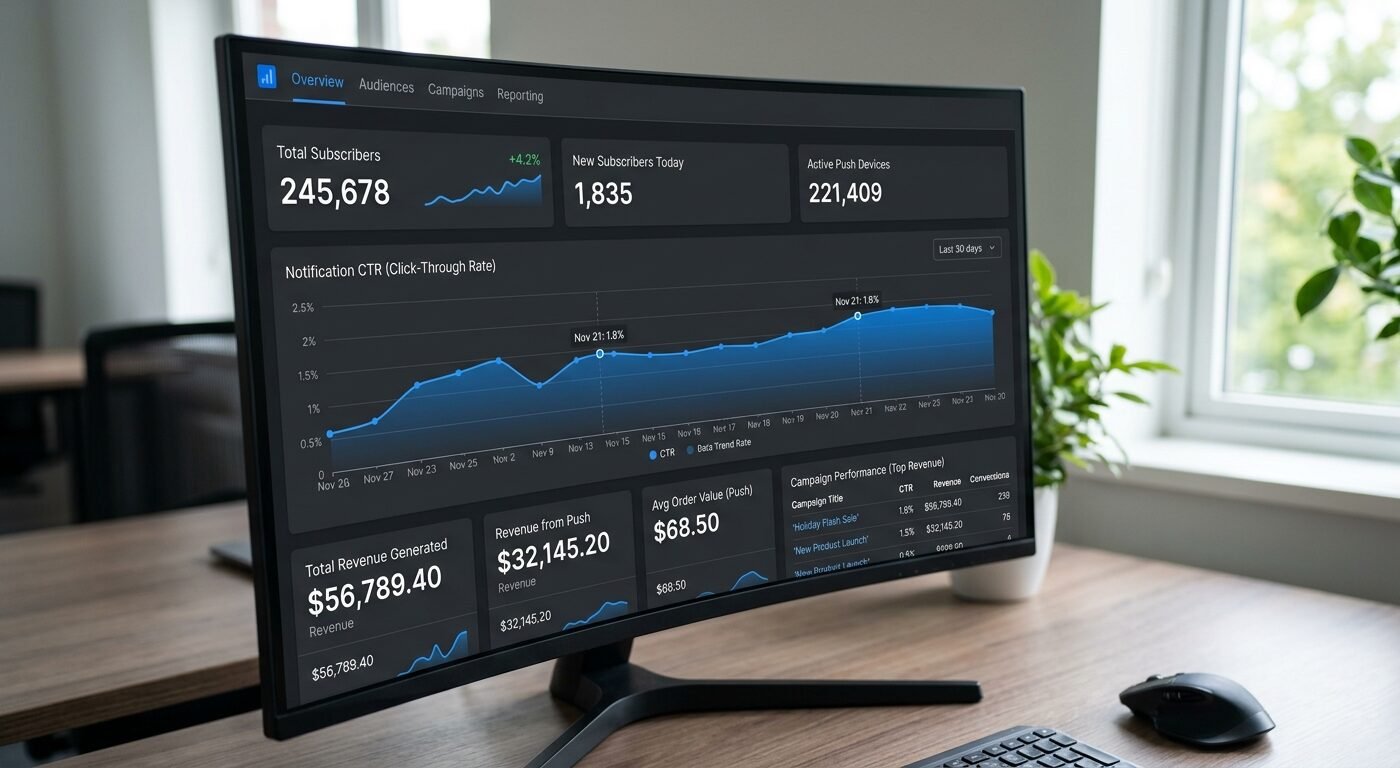
Subscriber engagement matters more than total subscriber count. If 30% of your subscribers click push notifications regularly, networks will pay you higher CPMs because your inventory converts. If your click-through rate is under 2%, CPMs drop because advertisers see your list as dead weight. RichAds and Megapush adjust CPMs dynamically based on engagement metrics. Managed networks like Adsterra won’t tell you the exact formula, but engagement directly impacts your revenue share.
Seasonal swings hit push notification CPMs harder than display ads. November and December see CPM spikes as e-commerce and affiliate advertisers increase budgets. January and February are slow — CPMs can drop 30% to 50% across all networks. If you’re testing networks for the first time, don’t do it in January. You’ll get a distorted picture of earnings.
Step 6: Evaluate Payment Methods and Net Terms
You can earn great CPMs and still wait 90 days to get paid if you pick the wrong network.
Most push notification platforms offer PayPal, Wire Transfer, and cryptocurrency. PayPal is fast but comes with fees — typically 2% to 3% per transaction. Adsterra, PropellerAds, and ExoClick all support PayPal with a $100 minimum payout. Wire transfer minimums are higher — $500 to $1,000 — and banks charge $15 to $40 in intermediary fees. Crypto payments (Bitcoin, USDT, or Ethereum) are gaining traction. Networks like Adsterra and Bitmedia offer crypto payouts with lower minimums ($50 to $100) and faster processing.
Net terms define when you get paid after you earn. Net-7 means you’re paid seven days after the end of the billing period. Net-30 means 30 days. Some networks, like Adsterra, offer Net-0 for high-volume publishers — you get paid the same week you earn. Others, like ExoClick, operate on Net-30 or Net-60 depending on your account status.
Beginner publishers should prioritize weekly payouts and low minimums. Waiting two months for your first $100 is demotivating. PropellerAds offers $100 minimums with weekly billing. Adsterra has $5 minimums for some payment methods but applies fees on smaller amounts. RichAds and Megapush require $50 to $100 minimums but pay Net-7, which is faster than most.
Watch for hidden fees. Some networks charge withdrawal fees on top of PayPal or bank fees. Others adjust your revenue share based on payment method — you might get 70% on Wire Transfer but only 65% on PayPal. Read the payment terms page before you sign up.
Step 7: Check Subscriber List Ownership and Portability
Most publishers don’t realize they’re building an asset they don’t own.
On managed platforms like PropellerAds, Adsterra, and ExoClick, the network owns your subscriber list. You can’t export it. You can’t move it to another network. If the network shuts down, bans your account, or changes revenue terms, you lose everything. This isn’t necessarily a dealbreaker — managed networks handle delivery infrastructure, compliance, and anti-spam monitoring, which saves you time and technical overhead. But you’re trading control for convenience.
Self-serve platforms like OneSignal, PushEngage, and Subscribers let you own your list. You can export subscriber tokens, migrate to another provider, or even run your own push server if you’ve got the technical setup. This flexibility matters if you’re building a long-term media property. Your subscriber base becomes a moat. You can negotiate higher rev shares, sell sponsored pushes directly to advertisers, or switch networks without losing your audience.
If you’re just starting out, managed networks are fine. You don’t have the scale to leverage list ownership yet. But once you hit 50,000+ subscribers, explore hybrid or self-serve setups. The ability to negotiate directly with advertisers or run your own campaigns can double your effective CPM.
Step 8: Look for Advertiser Demand in Your Specific Niche
High CPMs on a network’s homepage mean nothing if they don’t have advertisers in your vertical.
Some networks specialize. ExoClick dominates adult and gambling. Bitmedia owns the crypto vertical. TrafficJunky focuses on adult entertainment and dating. RichAds and Pushground cover e-commerce, finance, nutra (health supplements), and sweepstakes. PropellerAds and Adsterra are generalists — they monetize almost every niche but don’t always have deep advertiser demand in edge categories.
Check the network’s advertiser verticals before you apply. Most networks list them on their “Advertisers” page. If you’re running a forex education blog and the network’s advertiser page highlights dating and mobile games, your CPMs will suffer. Conversely, if you’re in iGaming (online betting and casino content) and the network explicitly lists iGaming as a top vertical, you’re in the right place.
Ask about fill rate during onboarding. Fill rate is the percentage of push impressions that get matched with a paying ad. A 90% fill rate means 10% of your impressions go unsold. In high-demand niches like finance or crypto, top networks hit 95%+ fill rates. In lower-demand niches or Tier 3 geos, fill rates drop to 60% to 80%. Networks rarely advertise fill rates publicly, but account managers will share them if you ask.
If a network consistently undersells your inventory, switch. We’ve seen publishers move from a generalist network to a niche-focused platform and double CPMs overnight — not because the new network paid more per impression, but because fill rate jumped from 65% to 98%.
Step 9: Test Multiple Networks and Track Real RPM
The only metric that matters is revenue per thousand subscribers (RPM), not CPM.
CPM measures what advertisers pay per thousand impressions. RPM measures what you actually earn per thousand subscribers after accounting for fill rate, click-through rate, and revenue share. A network advertising $3 CPM but delivering 70% fill rate and taking a 40% cut leaves you with an RPM under $1.30. Another network with a $2 CPM, 95% fill rate, and 20% cut gives you an RPM over $1.50. The second network makes you more money.
Run parallel tests. Sign up for two or three networks that accept your niche. Route traffic evenly (or use different geos or subdomains). Track RPM over 30 days. Ignore the first week — subscriber engagement takes time to stabilize. By week three, you’ll have clean data. Compare RPM, not CPM.
Don’t just look at revenue. Track unsubscribe rate. If one network sends aggressive, spammy notifications and your unsubscribe rate jumps 15% in a month, you’re killing your long-term asset for short-term revenue. Sustainable RPM beats one-month spikes.
Use a simple spreadsheet: columns for network name, total subscribers, total revenue, RPM, unsubscribe rate, and any notes (CPM spikes, seasonal events, account manager responsiveness). Update it monthly. After three months, you’ll know which network fits your niche best.
Frequently Asked Questions
What’s the minimum traffic needed to join push notification networks?
Most managed networks like PropellerAds and Adsterra prefer 30,000 monthly visitors, but they’ll approve smaller sites in high-value niches like finance or crypto. Self-serve platforms like OneSignal and PushEngage have no hard floor — you can start with 5,000 monthly visitors if your content is original and traffic is organic.
Do push notification networks accept adult or gambling sites?
Yes, but only specific ones. ExoClick, TrafficJunky, JuicyAds, and Adsterra all monetize adult and gambling traffic. Mainstream networks like OneSignal and PushEngage either reject these niches outright or restrict ad monetization features. Always check the network’s acceptable content policy before applying.
How much can I earn per subscriber per month?
It depends on your niche and geo mix. In Tier 1 finance or crypto niches, expect $0.05 to $0.15 per subscriber per month. In Tier 2/3 entertainment niches, $0.01 to $0.04 per subscriber per month is more realistic. Engagement rate and seasonal demand create wide variance — these are averages, not guarantees.
Can I use multiple push notification networks on the same site?
Technically yes, but it’s rarely worth it. Running two networks splits your subscriber base, complicates tracking, and often violates exclusivity clauses in managed platform agreements. Test networks sequentially, not simultaneously, unless you’re A/B testing on separate subdomains or traffic segments.
Ready to Monetize Your Traffic with the Right Push Network?
Choosing the right push notification network isn’t about picking the highest CPM on a comparison chart. It’s about matching your niche, your geo mix, and your audience behavior to a platform that has advertiser demand in your vertical.
Start with your traffic profile. Know your niche, your primary geos, and whether you’re in a high-value or edge category. Pick two networks that specialize in your vertical — one managed, one self-serve if possible. Run a 30-day test, track RPM, and watch unsubscribe rates. The network that delivers the best combination of revenue, fill rate, and subscriber retention wins.
At AdNetworksReview.com, we test and review push notification platforms across every niche — from mainstream tech blogs to edge verticals like adult, crypto, and gambling. Check our individual network reviews for approval requirements, real CPM data, and payment term breakdowns. No affiliate fluff. Just the numbers and the experience.