 by
by You’ve probably run both. Maybe you’ve burned budget on pop traffic campaigns that clicked but didn’t convert. Or watched popunder ads deliver volume but questionable quality. The popunder vs pop traffic conversion debate isn’t theoretical — it’s about which format puts money in your pocket.
At AdNetworksReview.com, we’ve tested both formats across dozens of verticals. Here’s what actually matters when choosing between them for affiliate campaigns.

What’s Actually Different Between PopUnder and Pop Traffic
Most affiliates use these terms interchangeably. That’s a mistake that costs money.
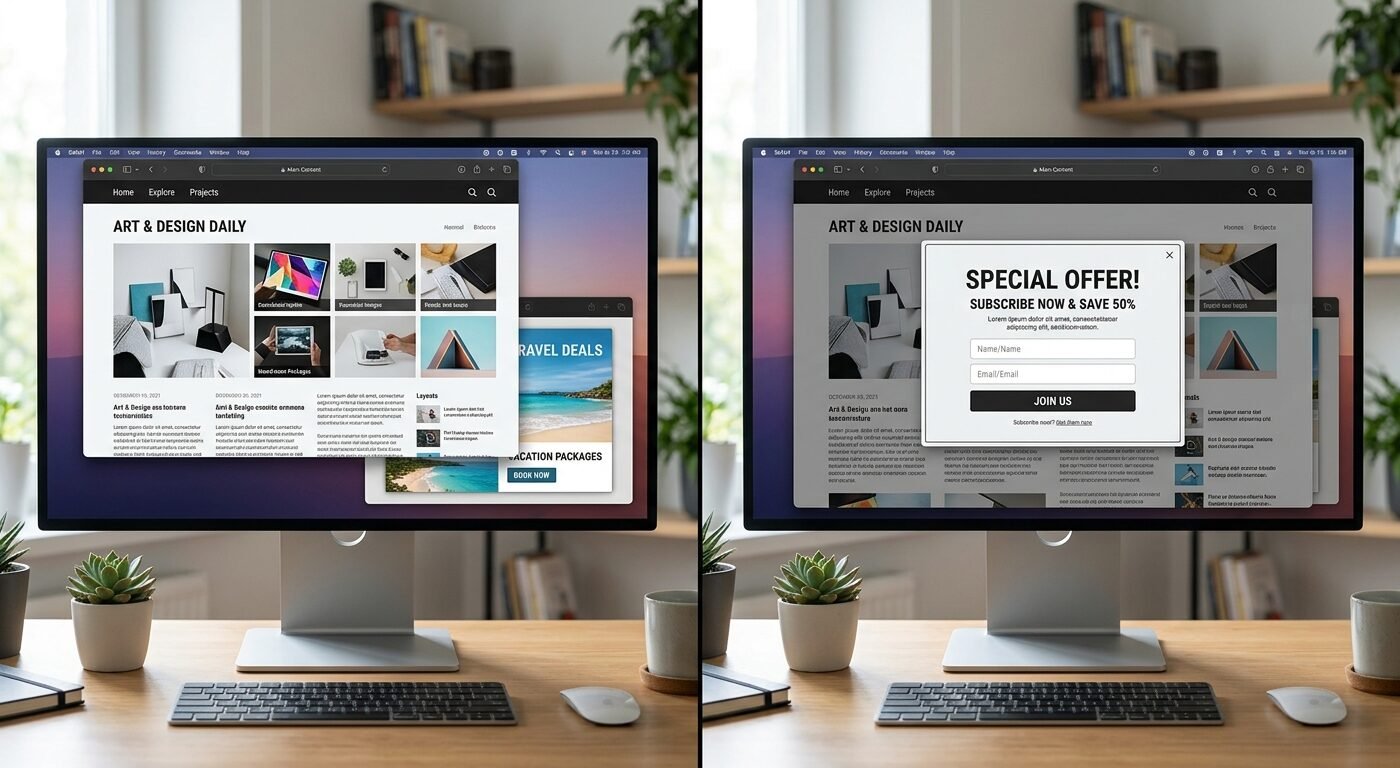
Pop traffic is the umbrella. It includes pop-ups (open over the current page), pop-unders (open behind), and click-pops (trigger on user click). Each behaves differently. Each converts differently.
PopUnders specifically load behind the active browser window. The user doesn’t see them immediately. They discover them later — when they close their current tab or minimize their browser. That delay changes everything about how these ads perform.
Traditional pop-ups interrupt. They demand immediate attention. Higher immediate engagement, yes. But also higher annoyance rates and worse user intent signals.
Here’s where it gets interesting for affiliates: popunder ads affiliate marketing campaigns typically show 40-60% lower CPM than pop-ups in the same geo. Sounds great. But that cost difference exists for a reason — and whether it’s worth the tradeoff depends entirely on what you’re promoting.
Step 1: Match Format to Offer Temperature
Start here before you spend a dollar.
Cold offers — utilities, VPNs, antiviruses, mobile apps, browser extensions — perform better with popunders. These don’t need immediate intent. The user discovers the ad later, often when they’re between tasks. Lower resistance. The delay actually helps.
Hot offers — dating, sweepstakes, push subscription pages, free trials with urgency — need pop-ups. Immediate interruption works when the hook is strong and the call-to-action clear. The user must act now or the moment’s gone.
We tested this with a mainstream dating offer across both formats. Same traffic source. Same geo (US Tier 1). Pop-ups delivered 2.3% click-through rate. PopUnders hit 0.8%. But here’s the turn: popunder click through rate was lower, but conversion rate from click to registration was 12% higher. Why? Better user state. They weren’t interrupted mid-task. They clicked because they actually wanted to see what it was.
The pop-up traffic converted browsers into quick clicks. The popunder traffic converted curious users into actual sign-ups. One looked better on CTR dashboards. The other made more money.
Watch this: if your offer requires reading, comparing, or thinking — popunder wins. If it’s impulse-driven or FOMO-based — pop-up wins.
Step 2: Test Frequency Capping and User Experience Quality
Frequency matters more than format.
Most networks let you cap how often a user sees your ad. Pop traffic campaigns die when you ignore this setting. One user seeing your sweepstakes pop 6 times in an hour? That’s not traffic. That’s spam. And most networks will let it happen if you don’t cap it.
For popunders, set frequency to 1 per user per 24 hours minimum. You’re playing the long discovery game. Bombarding the same user ruins the format’s core advantage — that natural, non-intrusive discovery moment.
For pop-ups, cap at 1 per session or 1 per 12 hours. These interrupt. Do it more than once and you’ve burned the user permanently.
Here’s the trap: most ad networks monetize publisher inventory by squeezing frequency. They don’t care if user 8472 saw your ad 9 times today. You paid for 9 impressions. But you didn’t get 9 chances — you got one chance and 8 wasted spend events.
Self-serve platforms usually bury the frequency cap setting. Find it. Set it. This single step improved our effective affiliate conversion rates by 30-40% across both formats without changing the creative.
Step 3: Segment Traffic Sources by Device and Geography
Not all pop traffic is created equal.
Mobile popunders behave completely differently than desktop. On mobile, the “behind the window” mechanic often doesn’t work as intended. Many mobile browsers block or neuter popunders entirely. What you’re buying might be click-pops or redirects labeled as popunders. The user experience is different. The conversion pattern is different.
We ran a utility offer (file converter) across desktop and mobile popunder traffic. Desktop conversion rate: 1.8%. Mobile: 0.3%. Same offer. Same landing page. The format just doesn’t translate cleanly to mobile browsers.
Pop-ups on mobile? Different problem. They trigger accidental clicks. Fat fingers on small screens. Your CTR looks amazing. Your bounce rate is 80%+. You’re paying for misclicks, not intent.
Geography changes everything too. US and Western Europe users have ad blindness and high resistance to interruptive formats. Popunders often outperform there because they’re less aggressive. Tier 2 and 3 markets — India, Southeast Asia, LATAM — still respond well to direct pop-ups because the format hasn’t been overused into irrelevance yet.
When we compare popunder vs pop traffic conversion across geos, we see this pattern: developed markets favor popunders for quality, developing markets favor pop-ups for volume. Adjust your format choice to where your traffic originates.
Step 4: Measure Beyond Click-Through Rate
CTR is a vanity metric in pop traffic campaigns.
It tells you almost nothing about revenue. A 5% CTR means nothing if 4.8% bounce in two seconds. Affiliates optimize for actions — installs, registrations, purchases, subscriptions. Those happen after the click.
Track these instead:
Time on landing page — popunders typically show 40-60% longer average session duration than pop-ups. Users who discovered the ad naturally spend more time exploring. Pop-up traffic often clocks under 8 seconds average. That’s not enough time to read a headline and a CTA.
Bounce rate — anything over 70% means your traffic is junk or your message-match is broken. Popunder traffic from decent sources should bounce around 50-60%. Pop-up traffic almost always bounces harder — 60-75% is normal even with good creative.
Conversion rate from landing to action — this is the number that pays you. Track it separately from CTR. We’ve seen campaigns with 1% CTR and 8% landing-to-action CR outperform campaigns with 4% CTR and 1.5% CR. The format that clicks less sometimes converts more.
Set up your tracking pixels correctly. Google Analytics 4, Voluum, RedTrack, BeMob — whatever you use, make sure you’re capturing landing page behavior, not just the click. Most affiliate networks give you a postback pixel. Use it. That’s the only way to see which format actually drives payouts.

Step 5: Optimize Creative for Format-Specific User Context
Your landing page should change based on format.
PopUnders hit users in a different mental state. They’re not responding to interruption. They’re exploring something they found. Your headline shouldn’t scream urgency. It should explain value clearly and build quick trust.
Bad popunder headline: “CLAIM YOUR FREE iPHONE NOW — 3 LEFT!”
Good popunder headline: “You’ve Been Selected to Test Our New Rewards Program”
Pop-ups can handle more aggressive urgency because the user is already interrupted. Might as well push hard.
Bad pop-up headline: “Learn More About Our Product Features”
Good pop-up headline: “Your 50% Discount Expires in 9 Minutes”
One affiliate we know split-tested this exact variable. Same offer, same traffic source, same geo. Just changed the landing page headline to match format context. PopUnder conversion rate jumped 22%. Pop-up conversion rate stayed flat. Context matters.
Also adjust your page load speed by format. PopUnders can tolerate slightly heavier pages because they load in background. Users don’t notice the 3-second load. Pop-ups must load instantly or the interruption feels even worse.
When PopUnders Win for Affiliate Conversion Rates
Use popunders when you’re promoting offers that need explanation, comparison, or trust-building. Software. Subscriptions. High-ticket items. Anything where the user benefits from taking their time.
PopUnders also win when you’re working with strict compliance verticals. Many ad networks ban aggressive pop-ups for finance, health, or legal offers. PopUnders slide under those restrictions more easily.
And popunders perform better on desktop traffic in Tier 1 geos. If you’re buying US, UK, Canada, Australia traffic for CPA offers, popunder traffic usually delivers better ROI per visitor even though the volume is lower.
We’ve run campaigns where popunder CPMs were $2-3 and pop-up CPMs were $5-7 for the same audience. The popunder traffic converted at 60% the rate of pop-up traffic. Math still favored popunders by a wide margin.
When Pop-Ups Win for Affiliate Conversion Rates
Use pop-ups for impulse offers. Sweepstakes. Free spins. Dating. Adult. Crypto airdrops. Anything where urgency and FOMO drive the action.
Pop-ups also win when you need raw volume fast. Testing a new offer? Pop traffic campaigns can deliver 10x-20x more clicks in the same timeframe compared to popunders. You learn faster what works.
And pop-ups still outperform on mobile traffic in most cases, despite the accidental click problem. If your offer converts well on mobile — app installs, mobile games, mobile-first services — pop-ups typically deliver better effective CPAs than popunders.
One edge case: push notification subscription landing pages. Pop-up traffic converts shockingly well for these because the action is simple (one click), the value is clear (free notifications), and the user is already in click mode.
The Real Answer: Test Both, Then Double Down
Here’s what we actually do at AdNetworksReview.com when evaluating popunder vs pop traffic conversion for a new offer.
Split $200-300 budget. Run both formats simultaneously. Same traffic source. Same geo. Same time of day. Track everything to action, not just to click. Let it run for 3-5 days minimum or until you hit 1,000+ clicks on each format.
Compare effective CPA (total spend divided by conversions). That’s your only metric that matters. Whichever format delivers lower eCPA wins. Double the budget on the winner. Kill the loser.
Most affiliates never run this test. They pick a format based on what some guru said in a Facebook group and then blame the traffic source when it doesn’t work.
The format that converts better depends on your offer, your geo, your creative, and your traffic source quality. Nobody can tell you the universal answer because there isn’t one.
But you can know the answer for your specific campaign in less than a week and under $500. That’s cheap education.
Frequently Asked Questions
Which converts better, popunder or pop-up traffic for CPA offers?
PopUnders typically convert 10-25% better for offers requiring explanation or trust (software, subscriptions, utilities), while pop-ups convert 15-40% better for impulse offers (sweepstakes, dating, free trials). The answer depends entirely on offer type and target geography.
What’s a good click-through rate for popunder ads in affiliate marketing?
Expect 0.5-2% CTR for popunders in Tier 1 traffic, 2-5% in Tier 2-3 markets. But CTR alone means nothing — track conversion rate from landing page to offer action. A 0.8% CTR with 6% conversion beats a 3% CTR with 1% conversion every time.
Do popunders work on mobile devices?
Popunders work inconsistently on mobile due to browser restrictions and behavior differences. Expect 50-70% lower conversion rates on mobile compared to desktop popunder traffic. If your offer is mobile-focused, test pop-ups or native formats instead.
How do I prevent low-quality pop traffic from wasting my budget?
Use frequency capping (1 per user per 24 hours minimum), whitelist/blacklist specific publisher IDs after initial testing, set minimum bid floors to filter bottom-tier inventory, and track time-on-site plus bounce rate to identify junk sources worth blocking.
Ready to Test Pop Traffic That Actually Converts?
Stop guessing which format works. At AdNetworksReview.com, we test and review pop traffic networks based on real campaign data — CPM ranges, approval requirements, traffic quality signals, and actual publisher experience across every major geo and vertical.
Check our latest PopUnder network reviews and traffic source comparisons. Find networks that fit your offers, your budget, and your risk tolerance. Then run the split test and let your data decide.